
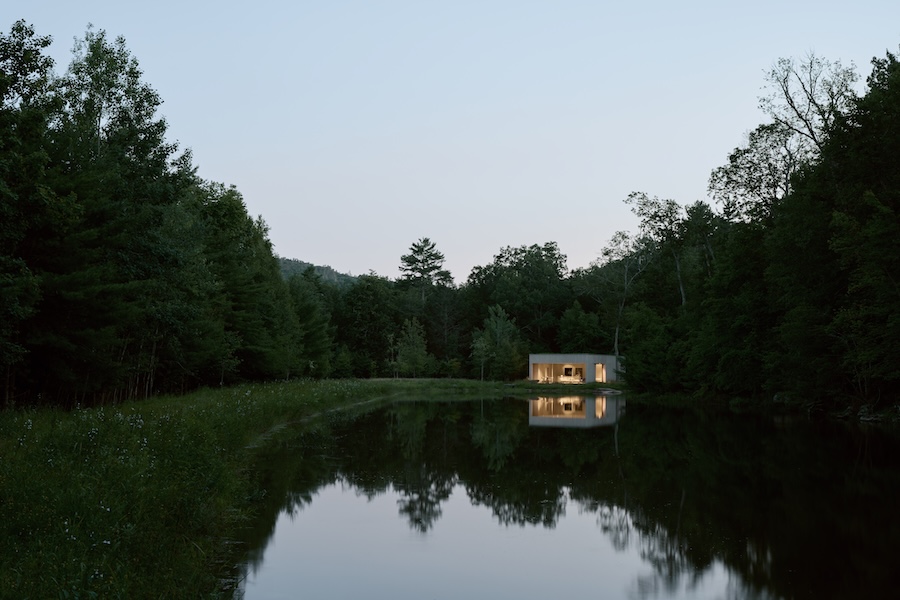
Danish design brand Vipp has debuted its first retreat in the U.S. Located in rural Upstate New York, the Vipp Pavilion represents the brand’s 15th bookable guesthouse globally.
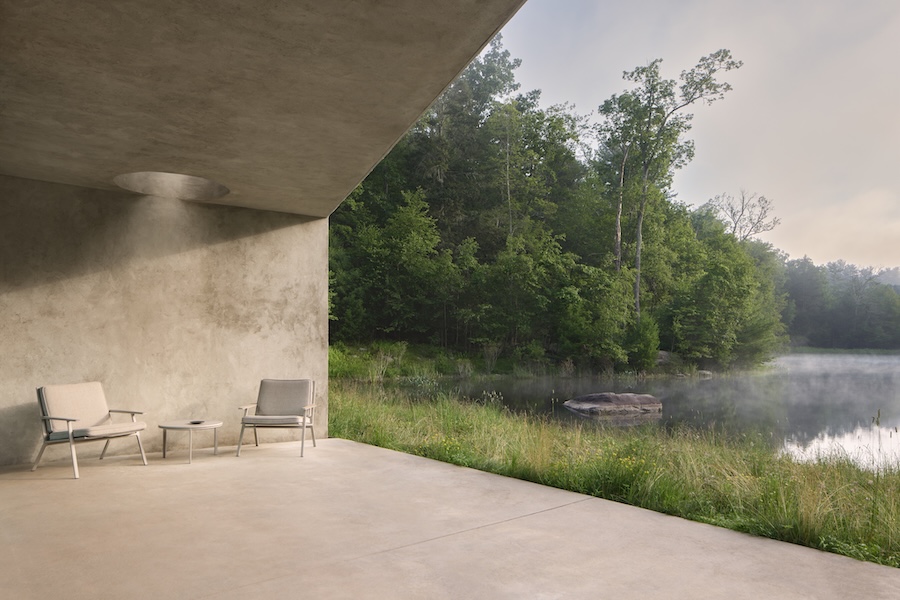
Envisioned by architecture firm Johnston Marklee as a sculptural object, the 1,200-square-foot property sits on the edge of a pond, immersed in 16 acres of scenic forest.
A design defined by geometry
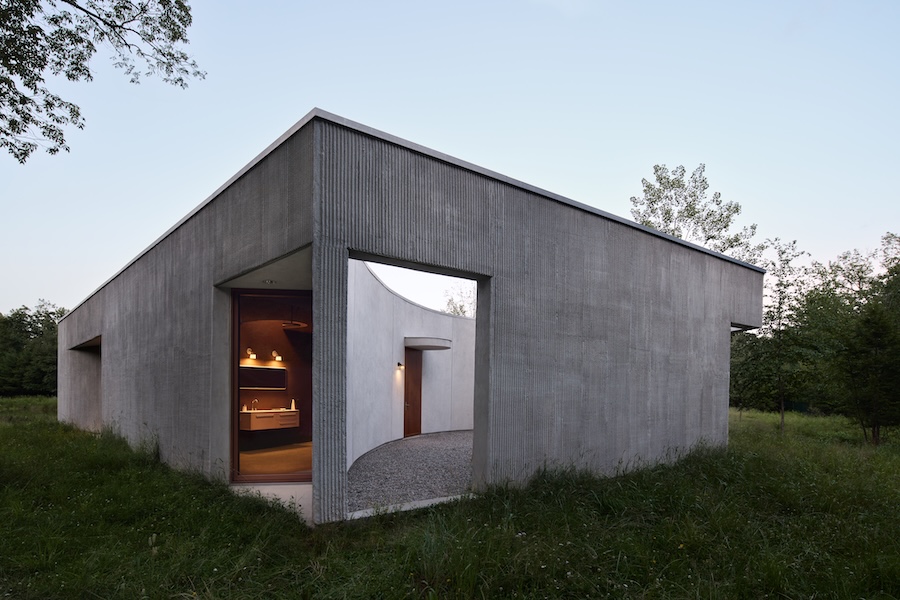
Four years in the making, the pavilion is constructed with a combination of smooth and ribbed stucco, its architectural form based on two tangent ellipses that echo the contours of the adjacent pond. Guests enter through a sweeping curved courtyard animated by arcs of light and shadow, drawing attention upward to frame the sky.

“At first glance, the building resembles a stone on the pond; initially solid, but slowly revealing its volumetric form on the approach,” explains Johnston Marklee founding partner Sharon Johnston.
The tactile interiors of Vipp Pavilion
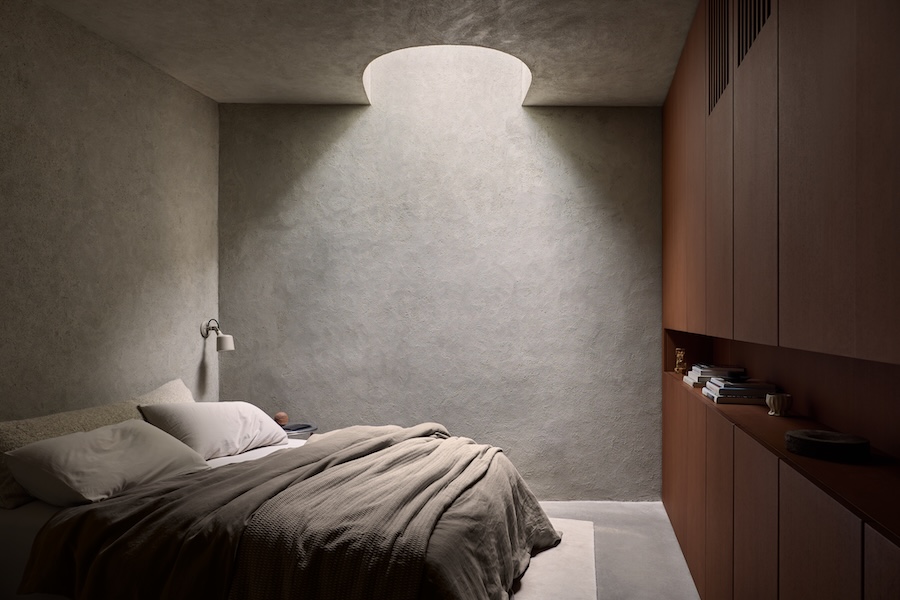
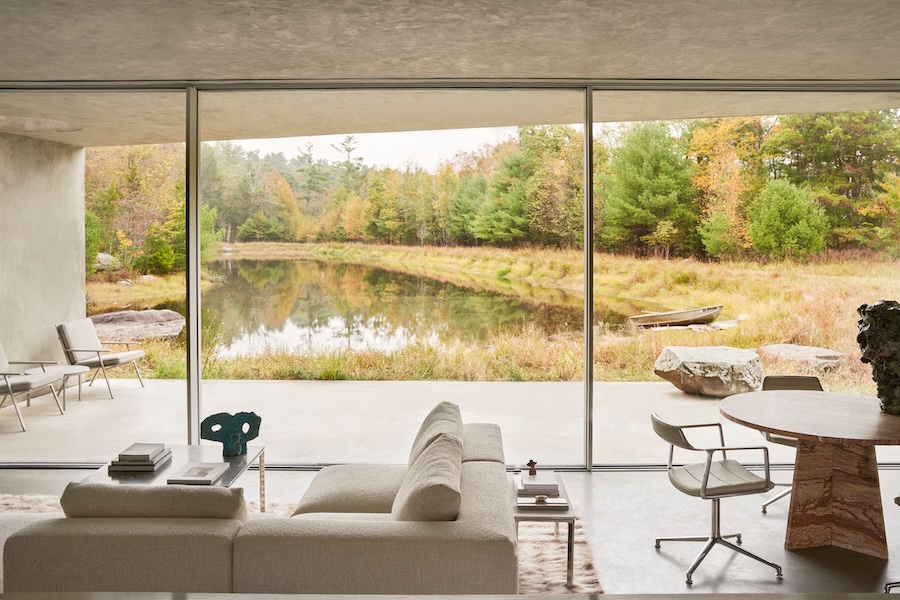
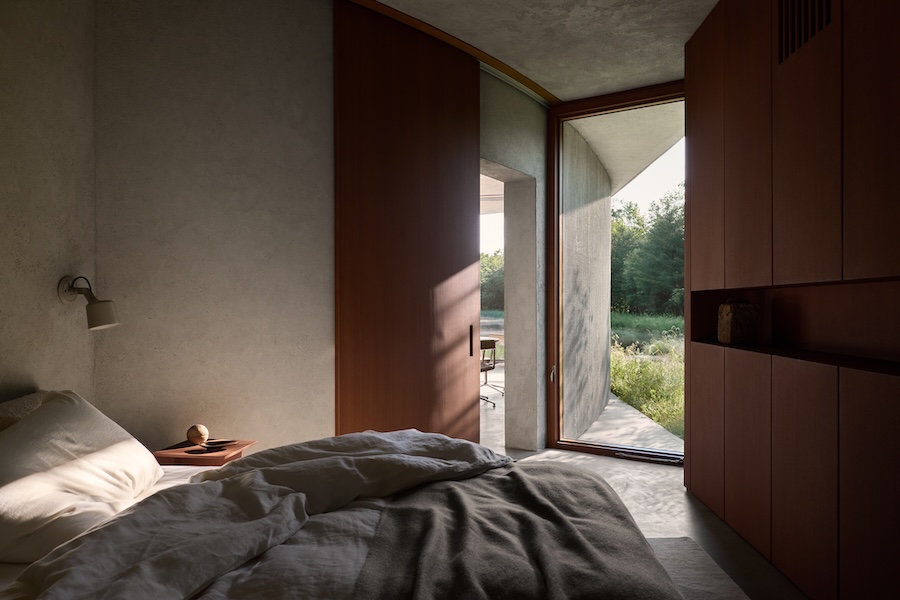
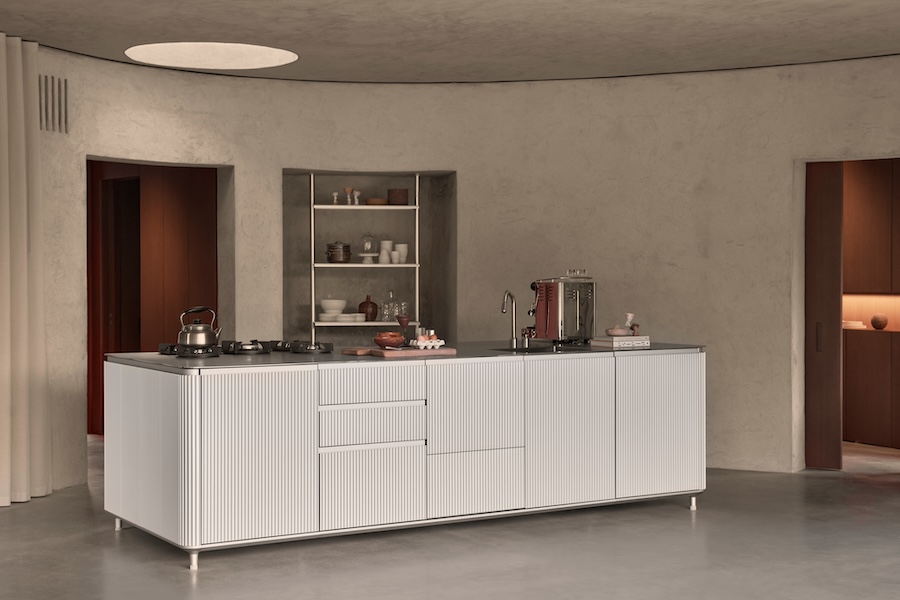
Passing inside at the tangent point between the two curves reveals a second elliptical room: a skylit, open space with raw concrete floors and rough stucco walls oriented toward a panoramic view of the water and meadow. Two bedrooms are tucked between curved walls featuring large mahogany-framed windows.
The interior palette channels the surrounding landscape, integrating the golden browns of autumn leaves, the grayish greens of moss, and the rich jade hues of fir trees.
Anchoring the main living space is an anodized aluminum kitchen, resting beneath a large circular skylight. Its rounded edges complement the building’s curved exterior, while acting as a striking counterpoint to the raw cement walls.
The tactile material palette is softened by wraparound curtains, a modular sofa, a custom earth-toned travertine table, and swivel chairs. Sapele wood millwork and window frames add warmth, while large floor-to-ceiling glass doors blur the lines between the interior spaces and the lush outdoors.
Rooted in nature
The property is nestled within a pastoral meadow and features a green roof, both designed by Larry Weaner Landscape Associates (LWLA). This landscape strategy emphasizes regional native plants and low-maintenance approaches, connecting the ground-level meadow to the house itself.
Johnston describes the pavilion as, “an autonomous structure that masks a sense of scale, form, or function in contrast with the surroundings as it frames and embraces the skies and forest. The abstract form doesn’t prescribe one’s engagement with the space or interior furnishings, rather each visitor will be able to shape their own experiences. It provides a retreat from the expected and a portal into nature.”
More from HD:
Finalists Announced for the 22nd Annual HD Awards
Aparthotels Gain Ground With Space, Service, and Style
Mackenzie Lewis and Tanner Moussa Forge a New Path