It’s not uncommon for Bosco Sodi to head into his studio in Brooklyn, New York’s Red Hook neighborhood in the middle of the night. “I’m obsessive. I cannot have an idea without acting on it immediately. Even if it’s 3 a.m. Sometimes the idea is terrible, sometimes the idea is good, but I cannot wait,” says the Mexico City-born artist.
The prolific Sodi doesn’t abide by routines. Inspiration might flow in the wee hours, or it might flow in the mornings. But in some capacity, he works every day. “I always come to the studio when I’m in town. Even if it’s to go around and look at the paintings or stretch the canvases,” he adds.
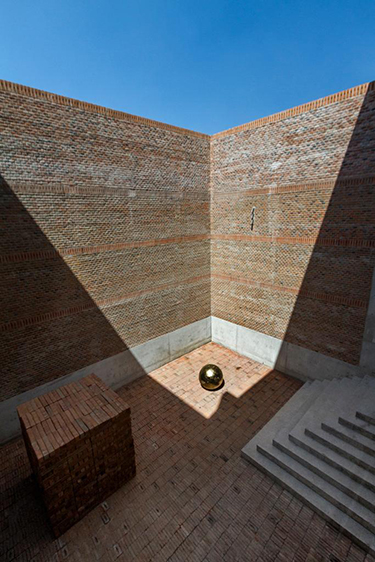
Sabino 336, the Alberto Kalach-designed Mexico City headquarters of Casa Wabi, features exposed brick and concrete
As a child, Sodi was diagnosed with ADHD and dyslexia, a challenging one-two punch that propelled his mother to send him off to Montessori art classes several times a week. “I used to choose the materials, and the teacher would tell me how to use them, not what to do, and that has been my therapy since I was 6 or 7 years old,” he explains.
Although Sodi enjoyed these reprieves from his other studies, he saw the benefits solely through a therapeutic lens. “I knew I was going to continue with it, but I didn’t know I was going to find a profession from it. When it became possible, of course, I was happy about it,” he says.
That possibility first manifested in the 1990s during Sodi’s time in Paris. He dropped off drawings he had dreamt up in therapy at the framing shop and when he returned, he was told that customers were eager to buy them. Finally, he felt that living off his passion was within reach.
Sodi later moved to Barcelona, where he slowly built his career from a bigger studio, making his way through the city’s gallery circuit. When Barcelona felt too small and too politically charged in the throes of the Catalan independence movement, Sodi gathered his savings and headed to New York in 2008.

In 2024, Bosco Sodi presented Dawns at the Johyun Gallery in Busan, South Korea, an installation melding gilded granite sculptures and sack paintings
His oeuvre is expansive. In 2025, he paid homage to his father by placing mixed-media canvases around a century-old olive tree in Berlin’s König Galerie and captured memories from his family’s Greek island hideaway in the blue paintings with beguiling, cracked surfaces recalling water-submerged rocks that graced Galeria Nuno Centeno in Porto, Portugal. The year prior, he brightened the Harvard Art Museums with 17 karat gold-glazed spheres.
“I like to move around and work across different disciplines because I don’t like to get used to things,” Sodi says. He craves the new, imbuing his large-scale paintings and sculptures with a sense of unpredictability and distinction. “I like to apply that philosophy day by day otherwise it won’t work as a therapy.”
But what unifies them is their primal allure fostered through Sodi’s embrace of raw materials such as clay, glaze, volcanic magma, and a dense paste of mineral pigments mixed with sawdust, wood, pulp, glue, and natural fibers.
“I like the feeling of touching it. My work is physical. I don’t have assistants; I do everything myself and so I like this exchange between the artist and the object and the materials,” he says.
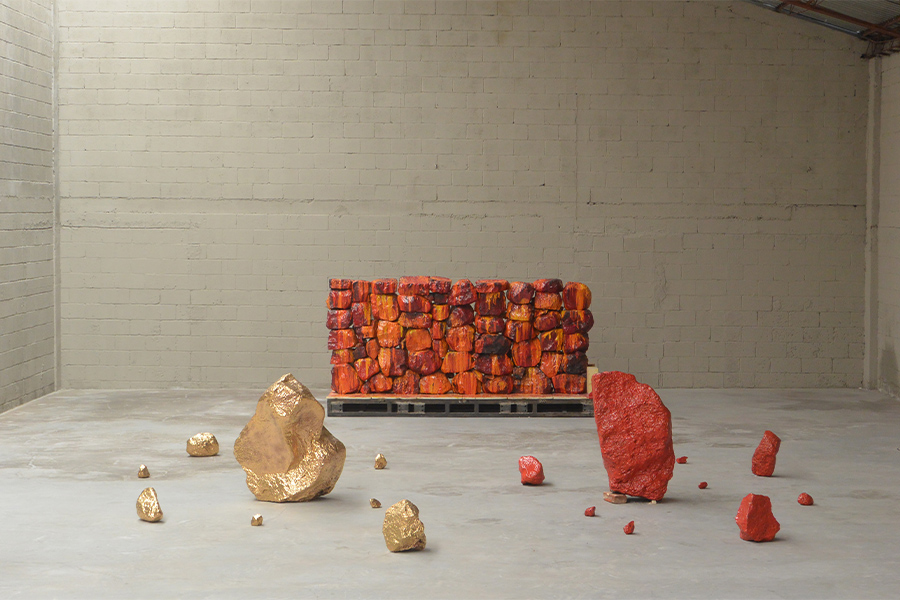
A glimpse into Sodi’s Mexico City studio
When Sodi becomes restless in New York, he visits his Mexico City office and studio or Casa Wabi, the nonprofit in Puerto Escondido that he launched in 2014 with his wife Lucia Corredor, cofounder and creative director of Mexico City design studio and showroom Decada. “I wanted to give back as much as possible to my country—especially to Oaxaca—to art, and my colleagues, all the artists,” he says of the reason behind the venture, which also has satellite locations in Mexico City and Tokyo.
Featuring an exhibition gallery, studios, and bedrooms, the Tadao Ando-designed retreat is an ode to wabi-sabi, the Japanese concept celebrating the beauty of imperfection that fuels Sodi’s creations. Assembly, a nonprofit museum dedicated to contemporary artists in Monticello, New York is another project founded by Sodi situated in an old Buick dealership brought to life by Mexican architect Alberto Kalach.
Sodi’s further sharpening his eye in this realm by collaborating with Meyer Davis on the forthcoming Mandarin Oriental beachfront resort and residences on Mexico’s Riviera Maya scheduled to open in 2028. As curator and design consultant, he’s assembling works from some 25 Mexican artists, many of them young, and weighing in on the property’s overall aesthetic. “We’re creating a collection made for the hotel. It’s not something to add in only after the hotel is finished,” he says.
A slate of exhibitions is planned for 2026 as well, including in Hong Kong, New York, and South Korea. “I try to do all the shows with a theme or color to make it solid, not a show for selling. I like to place objects in the middle of the floor to create tension with the paintings, making it site specific,” Sodi says. Consider the series of red paintings he recently unveiled at MtK Contemporary Art in Kyoto that honor the hue that fills the city’s temples.
No matter the context, “my work is much more about the process than the outcome, using organic materials and grounding objects,” he says. “Even the paintings look like objects because of the forces between them—how they create negative space in the surroundings.”

Light filters through Sodi’s Brooklyn, New York studio in Red Hook
This article originally appeared in HD’s November 2025 issue.