According to the latest World Tourism Barometer from UN Tourism, international tourist arrivals climbed 4 percent in 2025, signaling strong travel demand across the globe. This momentum is translating directly into development. Data from Lodging Econometrics (LE) shows that the global hotel construction pipeline reached 15,870 projects by Q4 2025, with the U.S. accounting for 6,146 projects and Asia following closely behind at 5,931, with 1,295 expected to open in 2026. As brands readjust their strategies in a changing geopolitical and economic landscape, the numbers suggest that 2026 will not only sustain last year’s gains but build on them, too.
This year, North America is drawing renewed attention as major sporting events and evolving trade dynamics help move projects ahead. In the U.S., momentum is building across major markets and the fast-growing Sun Belt. Phoenix, for example, is among the country’s most closely watched growth markets, with 23 projects slated to open this year alone, according to LE. “A lot of people are talking about development in [Phoenix] because of the growing population. People are [buying] larger homes, and people are also retiring there,” says Bruce Ford, senior vice president and director of global business development at LE.
Greater housing affordability and a strong job market—particularly in the booming semiconductor sector—has bolstered its appeal. Two forthcoming properties stand out: the Atari Hotel, slated to break ground this year with architecture by Räkkhaus, and the 236-key Denū Hotel and Spa, designed by Gensler.
On the West Coast, San Francisco is finding its footing again after a period of economic challenges, and showing new signs of life as tech workers return. Edouard Schwob, Accor’s senior vice president of development of luxury in the Americas, says the company has two projects in the works in the city. A year ago that would have been unlikely, “but we’re getting calls from investors looking to invest in San Francisco,” he says. “Now, with the AI boom and the number of startups that have opened in San Francisco, it’s like 2001 again.”
Additionally, two Hilton hotels in downtown were recently purchased for a combined $408 million, with renovation plans underway, while designer Ken Fulk will bring his distinct eye to the Huntington Hotel, a Highgate and Flynn Properties project slated to open this spring.
These movements reflect an industry that is readjusting rather than retreating. Below, we dive into the trends shaping 2026 across the globe.
Playing to Win
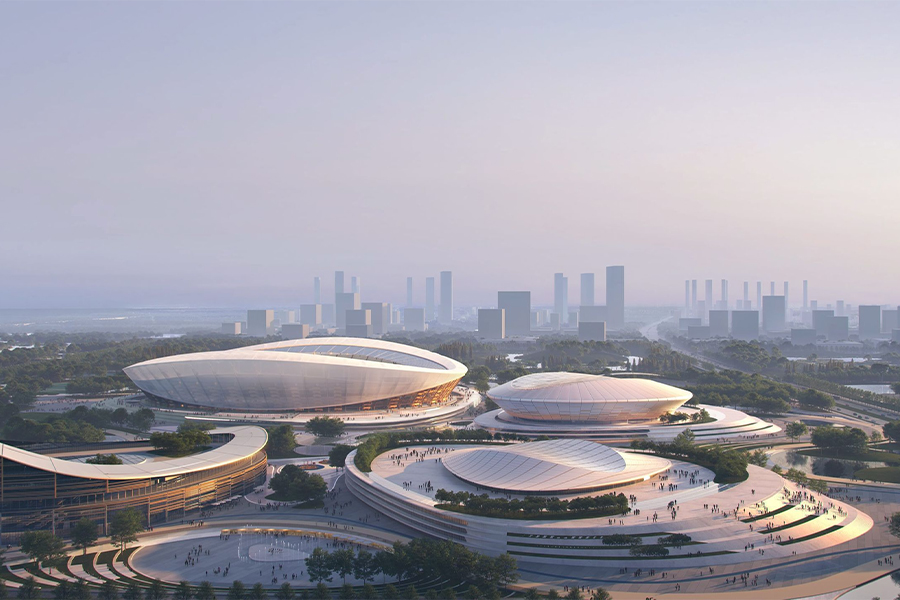
Envsioned by gmp Architects, the 60,000-seat Wuxi Olympic Sports Center anchors a 140-acre mixed-use park in China
With the Formula 1 Las Vegas Grand Prix in November, Super Bowl LXI at SoFi Stadium in 2027, and the 2028 Summer Olympics in Los Angeles, hospitality projects are now “tied to major global sporting events, where immovable deadlines are shaping procurement strategy and execution,” says Deborah Higgins, owner of procurement firm Canoe Hospitality.
She cites the firm’s work with the Venetian and Palazzo Resorts in Las Vegas and Kali Hotel in Los Angeles. Designed by Sixteenfifty Creative Intelligence, the Kali Hotel’s accommodations include Pro Suites tailored to professional athletes—think nine-foot-tall showers and ice bath service.
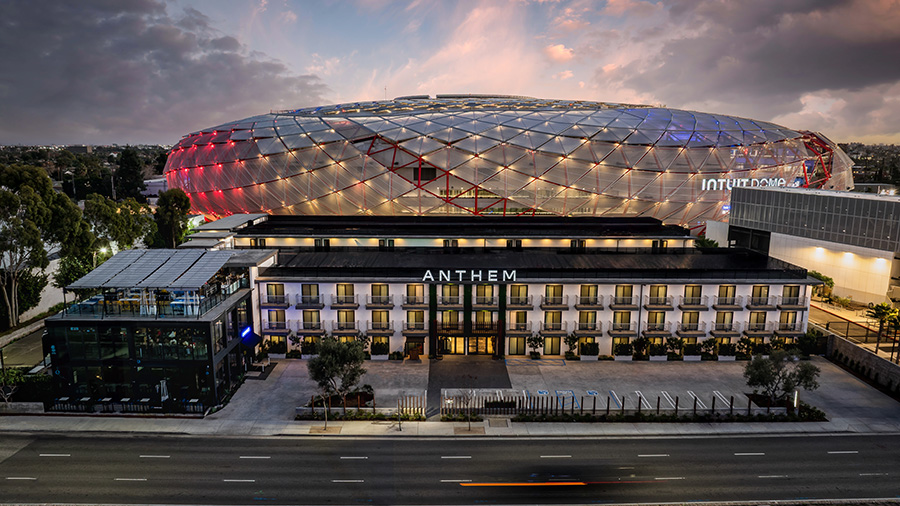
Steps from SoFi Stadium, the Anthem Hotel, a collaboration between Design 360 Unlimited and Finn Wijatno Architects, brings 179 guestrooms and an expansive pool deck to Los Angeles
Similarly, the 179-room Anthem, Tapestry Collection by Hilton, recently opened in the Stadium District near SoFi Stadium, with an oversized pool and flexible lounges from Design 360 Unlimited and Finn Wijatno Architects.
Around the world, the stadium is evolving into a central hub for development. In China, the Wuxi Olympic Sports Center, designed by gmp Architects, is part of a 140-acre park with a fitness center, hotel, apartments, and commercial facilities. “Enabling fans to dine, shop, and socialize nearby before and after events increases pre- and post-event spending and extends stay time as people arrive earlier and leave later,” says gmp Architects director Martin Glass. “An inclusive, accessible, and locally embedded venue promotes social and community integration.”
Conversion Momentum
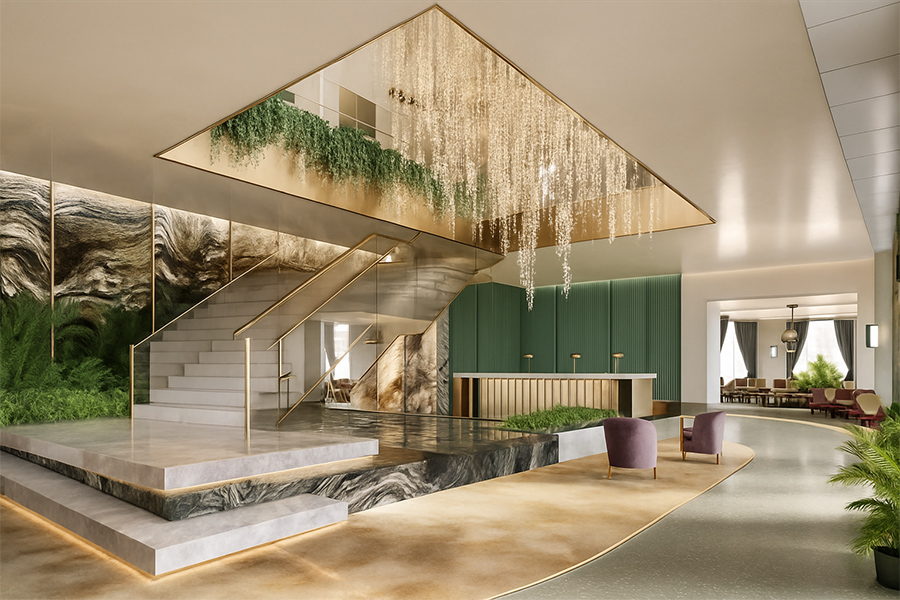
Fairmont New Orleans reimagines the former Bank of New Orleans Building as a 250-room luxury hotel, with interiors by Rockwell Group and architecture by Rozas Ward Architects
Conversions continue to be a go-to strategy amid construction and financing pressures. Renovations and brand conversions reached a record 2,118 in the U.S. at the close of Q4 2025, spanning every market from large-scale luxury to boutique. Take the Fairmont New Orleans, where Rockwell Group and Rozas Ward Architects will transform the former Bank of New Orleans building into a lively destination this year. At a more intimate scale, Lark Hotels’ 16-room Cambridge Common House in Massachusetts reimagines a historic townhouse with interiors by in-house studio Elder & Ash.
From a brand perspective, Minor Hotels recently launched a growth plan in North America, wherein “almost all our hotels are conversion friendly with built-in flexibility for localizing the brands in each market and different type of assets,” says Genna Panagopoulos, vice president of development, U.S. and Canada, at Minor Hotels.
DLR Group also cites repositionings, including the Benjamin in New York, now a Royal Sonesta. “The business traveler has come back, and people feel more comfortable going into those primary markets. Ownership groups are starting to see that,” says Joe Cicora, DLR Group’s national hospitality business development leader.
Europe, too, has a slew of openings this year, including Orient Express Palazzo Donà Giovannelli, a transformed 15th-century palazzo; Baccarat Hotel Rome, a conversion of Hotel Majestic Rome; and Cambridge House, a converted townhouse in London with 102 rooms and a private members club.
Clubs Within Hotels
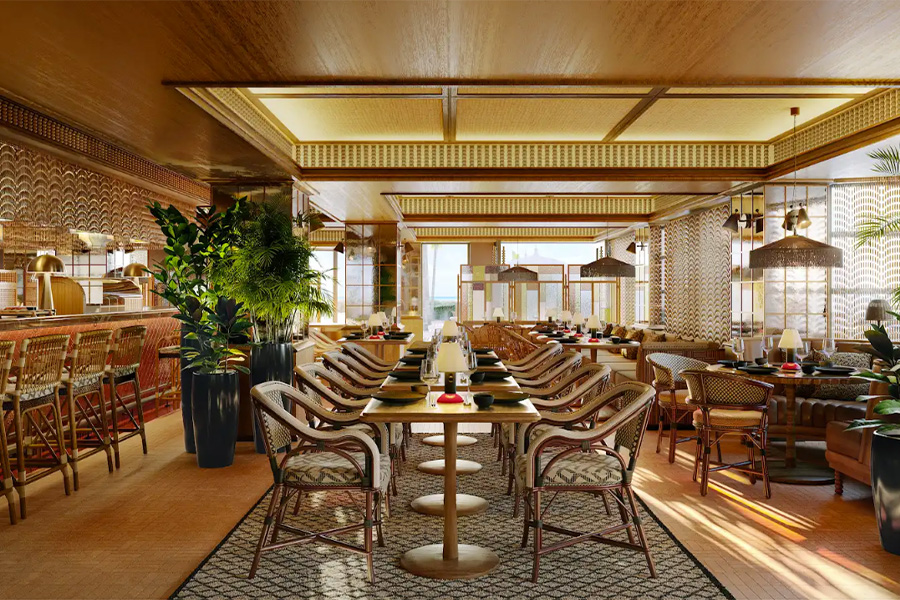
Greenery adds warmth to Gigi Rigolatto restaurant at Delano Miami Beach, renovated by Elastic Architects in collaboration with Ennismore’s in-house design team
More than ever, hotel spaces are offering flexible, revenue-generating social hubs. “Prioritizing flexible, multifunctional spaces will be one of the most impactful design decisions for hotels breaking ground in 2026,” says Gonzalo Bustamante, senior vice president of design at Starwood Hotels.
Members clubs are playing a major role in this shift. “Previously, we’ve seen hotels invite guests in for F&B or entertainment only, and now they’re inviting guests in to use their facilities as a membership program,” says Raymond Fort, vice president of Arquitectonica.
In Miami, that evolution began with beach clubs, where hotels offered local access to the shore. Today, the membership model extends across full-service amenities. For example, the newly reopened Delano Miami Beach, reimagined by Ennismore and Elastic Architects, offers not only beach access and cultural programming but also members-only spaces, including a dedicated pool and the Pirajean Lees-designed Mimi Kakushi restaurant.
“A few years ago, branded residences were the flavor. Now, the flavor is membership clubs,” adds Panagopoulos. “Almost every luxury deal I’ve looked at in the last year-and-a-half has had that. One of the three [forthcoming Minor] projects here in the U.S. will have one.”
Wellness as a Given
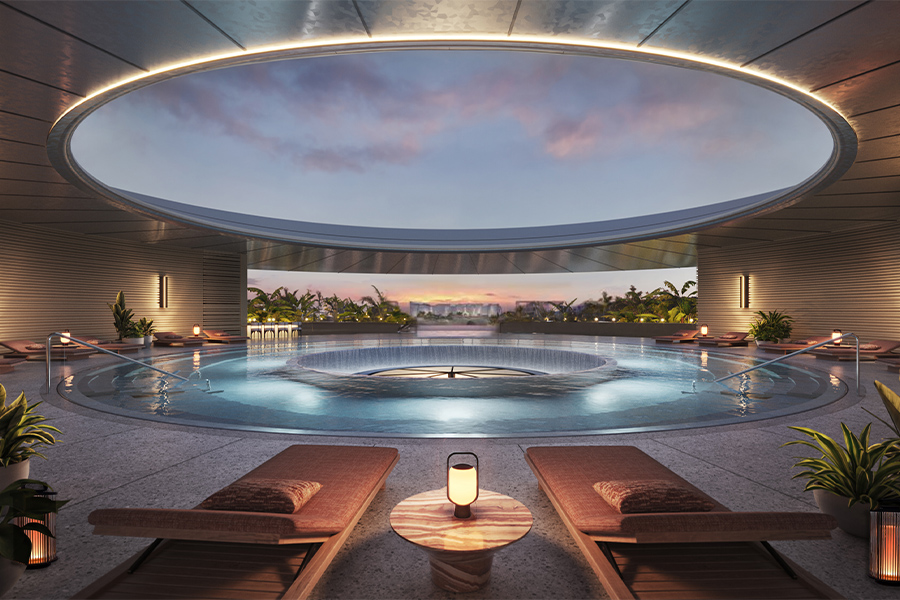
A skylight opens above the rooftop magnesium pool at Equinox Resort Amaala, a collaboration between Foster + Partners and Rockwell Group
“Wellness is less so a trend we’re going to see in 2026, but rather a paradigm shift in which our society is moving towards,” says Fort. Arquitectonica is currently working on SIRO Brickell, the wellness-focused brand’s first U.S. property, with 180 guestrooms, 350 branded residences, and Fitness and Recovery Labs.
Around the world, the emphasis continues. The Lake Como EDITION debuts this March with a longevity spa offering diagnostic assessments, while Equinox Resort Amaala in Saudi Arabia will introduce sleep-focused rooms and a 20,000-square-foot Equinox Club. The 18-key Amanvari opens this spring in Baja California with traditional Mexican sweat lodges and its signature Spa Houses. “It’s almost a given that you have this holistic approach in luxury, and now we’re seeing a lot of the midscale brands making that part of their offering,” says Schwob.
Higgins sees the same shift from the procurement side. “Features such as saunas, steam rooms, cold plunges, and treatment rooms are coming up more frequently in planning discussions, extending beyond luxury properties into 4-Star and boutique hotels.”
AI Behind the Scenes
As development advances, technology is increasingly operating in the background. “Our time itself is a luxury, and that’s been addressed by contactless check-in, mobile phone keys, and voice assistants in rooms tied to the property management system becoming more common,” says Eric Jassin, senior vice president of JLL Project and Development Services.
Still, caution remains. “We’re being extremely careful,” says Schwob. “It’s most useful in the back of house—optimizing systems, automating, maintenance, and we can keep the guest interface very human.”
There’s a future where hotels will deeply understand their guests through technology, but Schwob warns of its dangers. “One, you don’t want to be creepy and know too much about your guests. There are data protection issues in many jurisdictions, so we’re careful about that. And two, AI is not yet creating something [more] special than the human eye.”
Hyper-Local With Heart
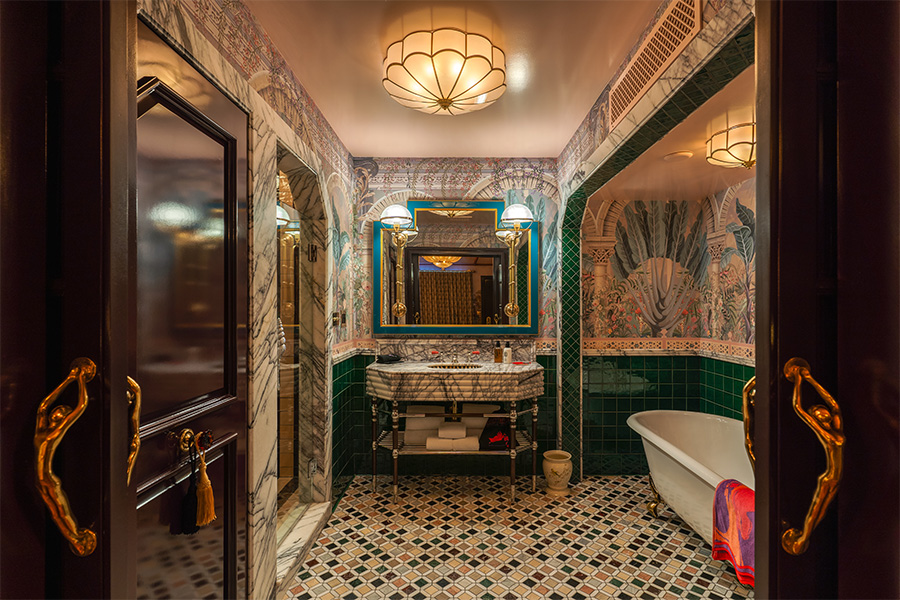
Post Company pays homage to California’s dreamy, sundrenched lifestyle at the forthcoming Baby Grand hotel in San Diego; photo by Kimberly Motos
Even as portfolios expand globally, there is a pull toward rooted, intimate spaces. “People are embracing smaller hotels where they can get personalized experiences,” says Schwob, pointing to Raffles Estera East Cape Resort & Residences in Mexico, with 80 rooms being designed by Studio Paolo Ferrari, 46 residences by Huber Design, and architecture by Olson Kundig.
Other projects echo this sentiment. The forthcoming 35-room Herons Lodge in Carmel-by-the-Sea, designed by Nina Freudenberger, channels the town’s nostalgic character through restrained interiors and locally sourced goods. Meanwhile, the newly opened Post Company-designed Baby Grand in San Diego from CH Projects layers custom wallpaper, antiques, and sculptural furnishings into a motel-inspired setting that feels distinctly of its place.
“Luxury has moved away from formalities,” says Panagopoulos. “What I’ve seen, especially on the design side, is localization. People don’t want to see the marble from Italy in the Caribbean—they want to see materials that are indigenous.”
Big brands are also taking notes, with Accor recently launching its Emblems Collection, which is about hyper-local, heritage locations. IHG also introduced the Noted Collection, a premium brand of distinct, story-driven hotels.
“Designs and the materials integrated are becoming warmer, more tactile, with bold patterns, layered textures, and sculptural forms,” adds Jassin. “Terms like hyper-local, quiet luxury, and design-to-feel have been buzzing. The question one might ask someone who’s had a great luxury experience moves from ‘Did you enjoy the property?’ toward ‘How were you changed by your experience?’”
This article originally appeared in HD’s February/March 2026 issue.