When it comes to a good restaurant or bar, sometimes one just isn’t enough. A new generation of dual- and even multi-concept F&B spaces are redefining how dining narratives are told.
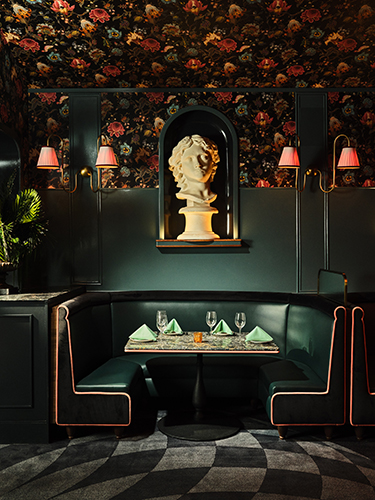
A sculpture by Anthony Hart punctuates a seating area at Vulture in San Diego
Dreamboat and Vulture, for instance, opened earlier this year at the same San Diego address sporting two strikingly different vibes. Designed by Brooklyn, New York firm Home Studios, the 10-seat Dreamboat diner channels early-20th-century Viennese design, while the richly layered, 4,400-square-foot vegan restaurant Vulture just beyond boasts neoclassical forms and a romantic, cinematic sensibility.
Then there’s Experimental Cocktail Club in New York’s Flatiron area, a subterranean lounge space bedecked with Art Nouveau influences and modern design flourishes located below La Compagnie wine bar, which features celestial-inspired interiors thanks to light fixtures with cosmos motifs and moon-themed fabrics. Both spaces are the handiwork of Paris-based designer Dorothée Meilichzon.
Restaurateurs around the country are embracing the power of contrast and connection—showing how two (or more) distinct environments can tell a richer, more resonant story together. Here, we delve into four more sibling spaces with complementary identities that deepen the guest journey.
Sip & Guzzle
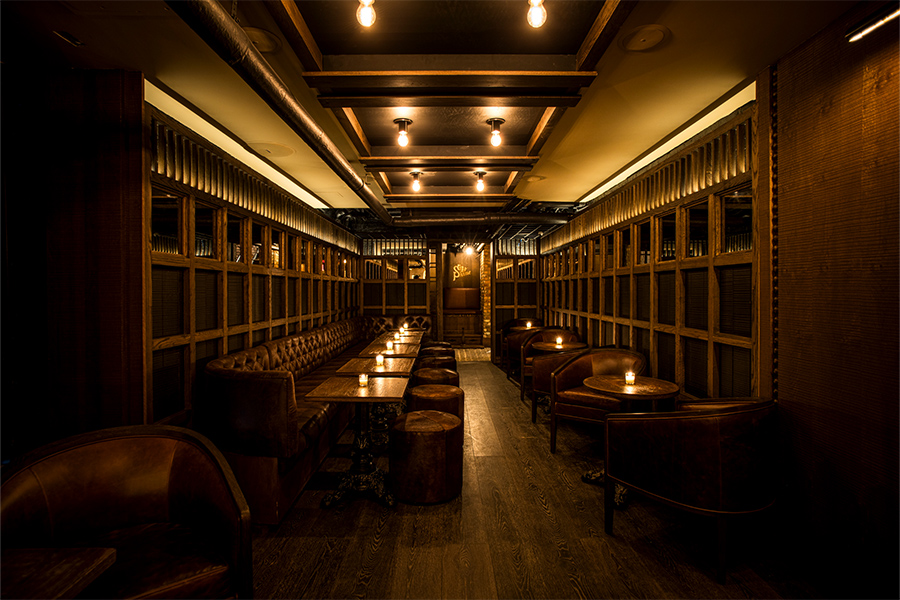
Sip, located below Guzzle, evokes the intimacy of a Shibuya back-alley bar
In Manhattan’s West Village, Sip & Guzzle tells a bicontinental story that expands upon the ethos of renowned Tokyo cocktail bar the SG Club (opened by Sip & Guzzle partner Shingo Gokan in 2018) by “fusing the best of New York and Tokyo under one roof,” says Sip & Guzzle co-owner Justin Weitz.
To achieve a cohesive fusion, the Sip & Guzzle team enlisted Tokyo-based Atsuhiko Sugiyama of the Whole Design, a frequent collaborator of Gokan, and New York-based designer Hiromi Murayama to bring the vision to life.
The ground floor Guzzle is reminiscent of a lively New York tavern from the 1860s, the era when a historic Japanese diplomatic mission voyaged to the U.S. Here, old brick and classic millwork melds with distressed white oak floors to create a warm, welcoming atmosphere. Artwork, including black-and-white photographs of landmark buildings and images of rockstars visiting Japan, bridges a connection between the two cities.
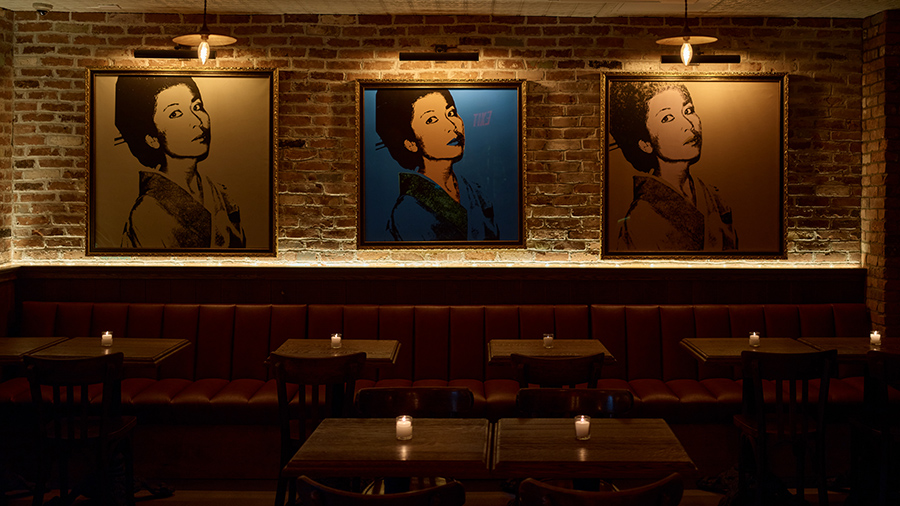
A trio of Andy Warhol’s Kimiko Powers prints hang above banquette seating at Guzzle
Below, Sip offers an intimate, sophisticated setting that draws on Japanese izakaya aesthetics while channeling New York’s speakeasy tradition. “The décor and overall feel are meant to evoke the sensation of being in the hull of an 1860s ship,” Weitz says.
“If we’ve done our job well, guests leave having tasted a little of everything: something familiar, something adventurous, something high, something low—a lively party upstairs and an elegant speakeasy downstairs,” Weitz says. “But most importantly, they leave with a true taste of both New York and Tokyo, two cities we deeply love and that profoundly shape everything we do.”
Kabawa and Bar Kabawa
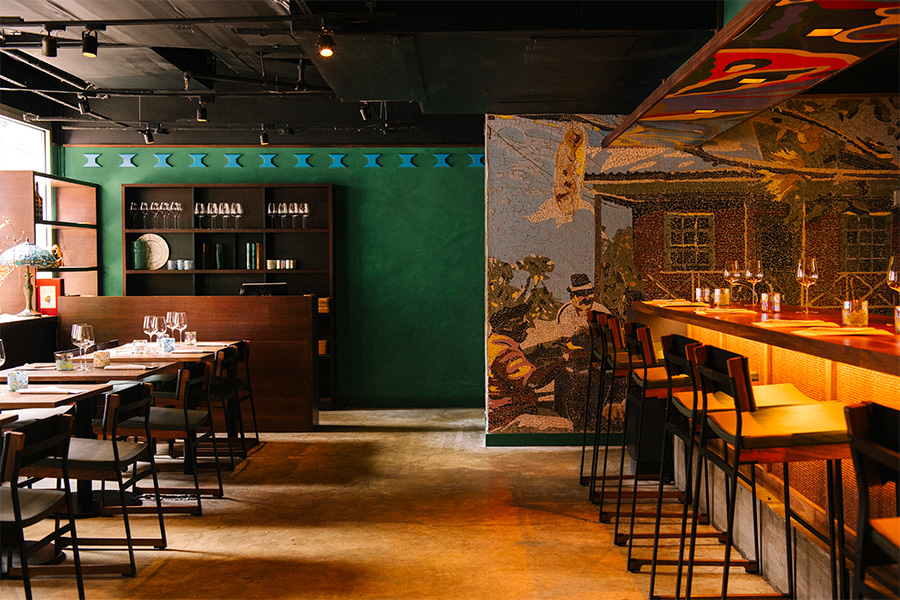
Kabawa restaurant pays homage to Caribbean culture, cuisine, and craftsmanship
In February, chef Paul Carmichael and Momofuku introduced Bar Kabawa in New York’s East Village neighborhood. Kabawa restaurant joined the following month one door down.
Carmichael, a native of Barbados, worked with Joseph Alayón Ormaza of New York- and Puerto Rico-based design studio Suite to craft two distinct venues that honor the Caribbean region.
“The design intent for both spaces came about by wanting to create spaces that truly feel like the Caribbean,” Carmichael says. “Not in the sense of how it’s usually displayed, which is a beach paradise or vacation, but a place that is genuinely us.”
Although common threads—like works by Dominican-American artist Raelis Vasquez and menu typography that flaunts Carmichael’s mother’s handwriting—weave Kabawa and Bar Kabawa together, the spaces maintain individual identities. “Think about how different two siblings can be—same parents, wildly different personalities,” says Carmichael. “I want to showcase that. They share a background, but they’re distinctly unique and their own.”
The focus is on the action in the kitchen at Kabawa. With its pre-fixe-style menu, the restaurant offers the experience of exploring countries through food at your own pace. However, Bar Kabawa is, as Carmichael puts it, “Kabawa’s wild sibling that loves to party. It’s a place where you go for a vibe, to meet people, to share, play some cards or dominos, and to be a bit raucous.”
DubuHaus, Howoo, and Musaek
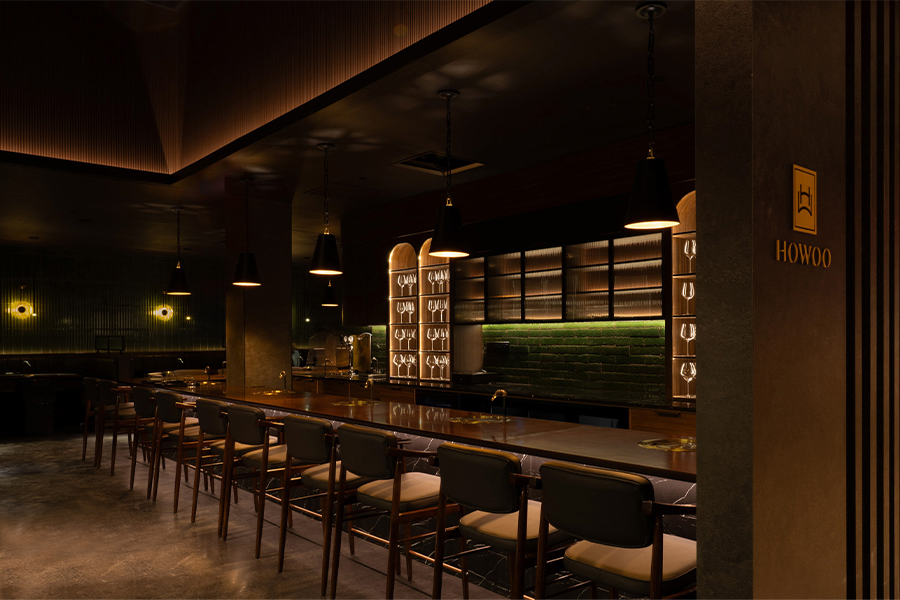
The bar at Howoo is defined by deep green-tiled walls, brass fixtures, and warm wood tones
Urimat Hospitality’s tri-level dining complex in the Koreatown section of New York was fully realized with the July launch of Musaek. The 12,000-square-foot seafood and cocktail bar sits beneath its two sister concepts: Howoo, an upscale Korean barbecue restaurant that opened its doors in March, and DubuHaus, a tofu-focused concept that debuted in April.
“Urimat was built on the idea that Korean cuisine is not one flavor, but a full spectrum of experiences,” says Jun Ho Moon, CEO of Urimat Hospitality. “Instead of compressing everything into a single restaurant, we wanted each culinary story to have its own space, its own rhythm, and its own craft. By dividing the footprint into three concepts, we could honor the depth of Korean food culture in a more intentional way.”
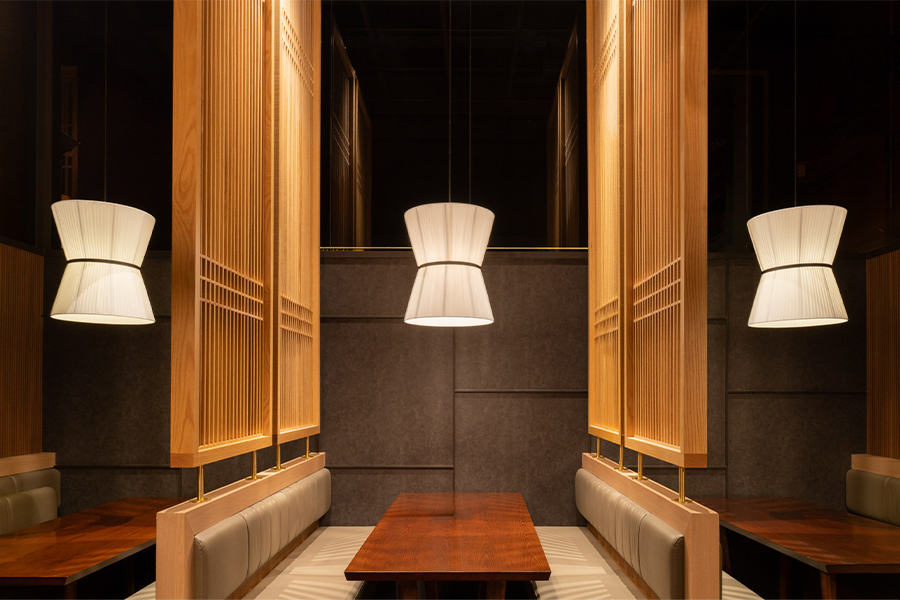
Wooden lattice partitions at DubuHaus provide privacy while maintaining a sense of openness
Though bound by a mutual foundation of Korean style, each space showcases its own interpretation. At DubuHaus, warm woods, natural textures, and tools convey classic dubu craft. Howoo, meanwhile, employs heavier, more architectural elements that take cues from hanok roof tiles and the structure of Korean barbecue rituals, and Musaek conveys Korean minimalism through shadows, metal, and fluid forms that reflect its ever-shifting identity.
“Each concept stands confidently on its own, but when experienced together, they reveal the full spectrum of what Korean dining can be—comforting, communal, and creatively forward,” Moon adds. “Ultimately, we want patrons to feel that Urimat offers not just three restaurants, but three perspectives of one culinary identity.”
Judy & Harry’s
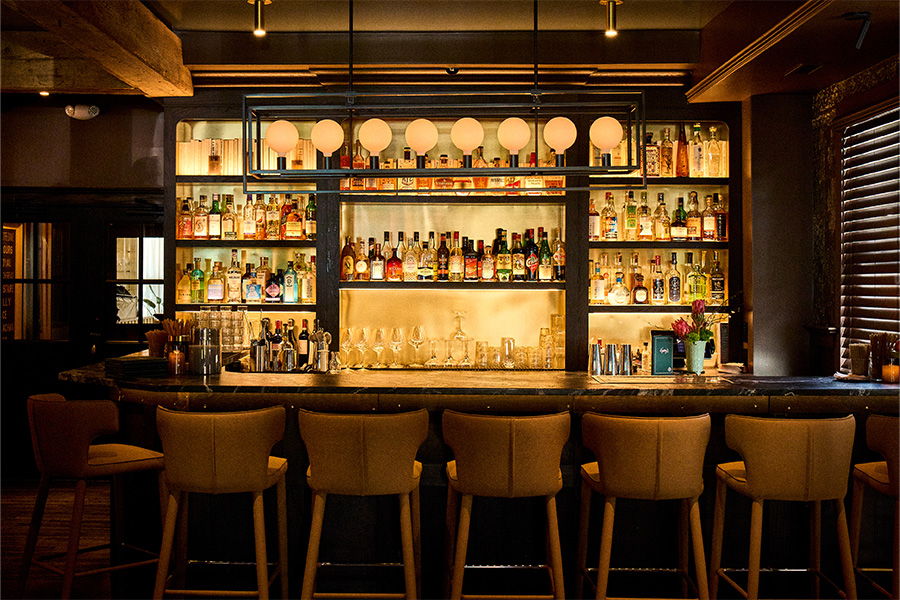
The moody, intimate Harry’s bar leads to Judy’s restaurant in Asbury Park, New Jersey
On the Jersey Shore, a historic 1886 building in Asbury Park that was home to New Jersey’s first woman-owned hotel continues to respect legacies both past and present. The structure’s second and third floors feature the St. Laurent’s 20 guestrooms, while the ground floor is occupied by Judy & Harry’s, two concepts from restaurateurs Neilly Robinson and David Viana of Good Trouble Hospitality.
Judy’s, an Italian restaurant with Jewish and international flair, is named after Robinson’s mom, while Harry’s lounge pays homage to both Harry Cipriani and Robinson’s father. “In many ways, Harry’s is Judy’s natural counterpart: similar, deeply connected, yet distinct in its beverage identity,” says Robinson. “Like 50 years of marriage, the two concepts balance and complete one another.”
Upon entering, guests are met by a moody, intimate setting at Harry’s that gives way to a much lighter, airier atmosphere at Judy’s, which is framed by garage doors that open out to a pool. Original 19th-century tin ceilings were preserved in both spaces.
“The spaces speak in subtlety,” Robinson says, who partnered with designer Stephanie Leopold and hospitality consultant Tania Kalian on the renovation project. “They are, by design, restrained canvases that allow the food, beverage, and hospitality to take centerstage. It’s less about matching aesthetics and more about crafting a feeling. The lighting, the textures, the hum of conversation, the rhythm of the open kitchen or the sound of a perfectly executed shake behind the bar—each element creates an atmosphere where the senses lead.”
Photos by Sasha Arutyunova, Adrianna Glaviano, Eric Medsker, and Michael Persico, James Tran, Brett Wood, and courtesy of Urimat Hospitality
This article originally appeared in HD’s December 2025 issue.