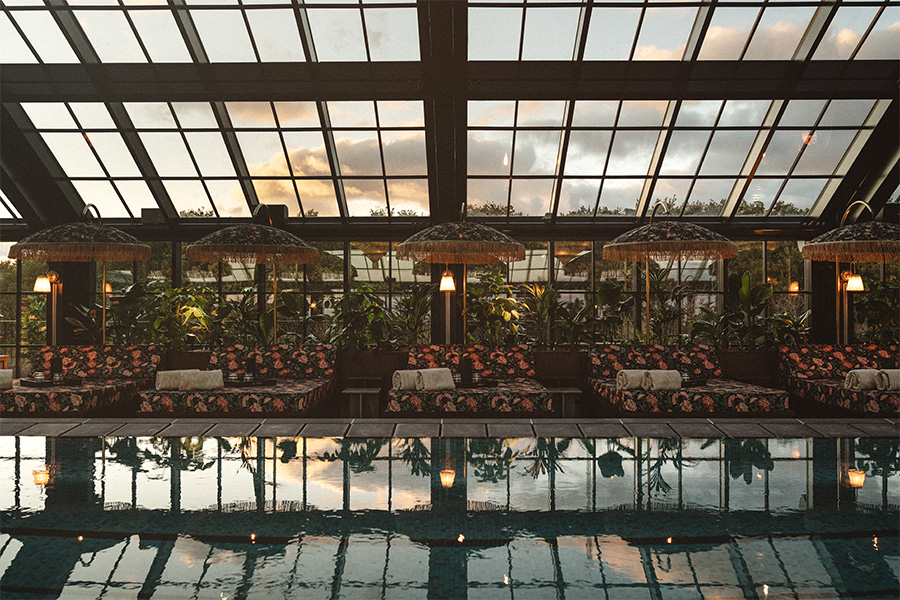
Before the Waldorf Astoria’s arrival of Peacock Alley, the opulent passageway doubling as a Gilded Age social hub, its two buildings were competing hotels from once-feuding cousins William Waldorf Astor and John Jacob Astor IV.
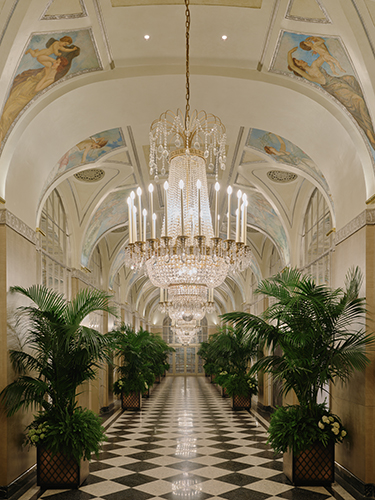
The Silver corridor linking WANY’s event venues is enlivened by 16 Edward Emerson Simmons murals that were brought back to life by a team of conservationists
When the Waldorf Astoria was razed to make way for the Empire State Building in 1929, it made a splashy comeback two years later in a Schultze & Weaver building engulfing an entire city block between Park and Lexington Avenues.
Over the years, politicians flocked to it, the Grand Ballroom hosted Rock & Roll Hall of Fame ceremonies, and countless locals met by the lobby’s famous clock first designed for the 1893 Chicago World’s Fair.
Now, after a monumental eight-year overhaul led by Skidmore, Owings & Merrill (SOM) and Pierre-Yves Rochon (PYR), the Hilton-operated Waldorf Astoria New York (WANY) exudes a sheen of grandeur befitting of its late-19th-century roots.
Invigorating a Legend
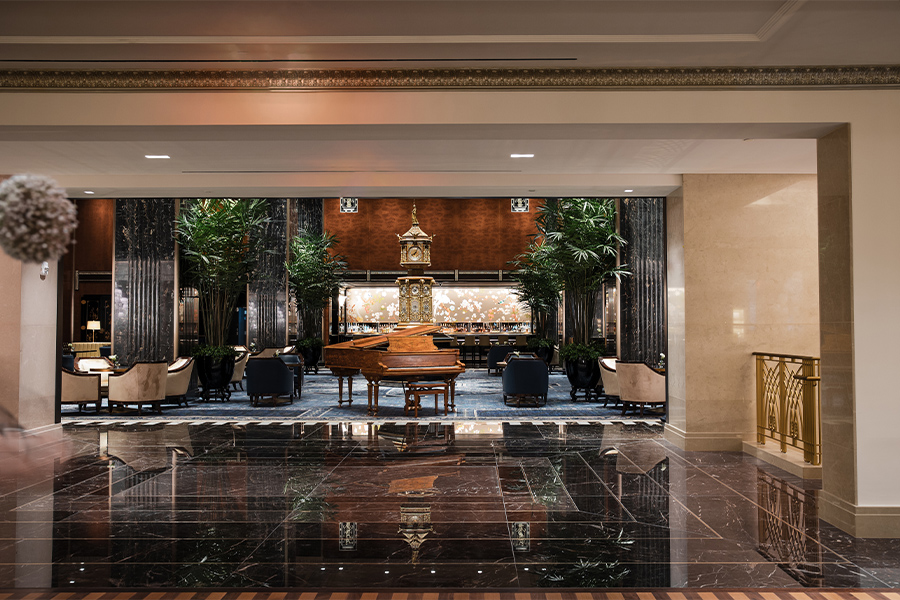
In Peacock Alley, Cole Porter’s custom-built Steinway piano from 1907 and the hotel’s iconic clock, designed for the 1893 Chicago World’s Fair, were both restored
Frank Mahan, design principal at SOM’s New York studio, believes it was the dawn of the jet age when WANY “began a slow decline,” he says. “Architectural modernism was ascendant, the location was dependent upon proximity to Grand Central Station, and the hotel responded by beginning to renovate, not often in sympathetic ways.”
Despite WANY’s falloff, it was still entrenched in New York lore when it shuttered in 2017, and ownership was mindful of the myriad memories attached to it. “People get sensitive about historic properties,” points out Chantell Walsh, vice president of design and construction at Strategic Hotels & Resorts, which owns the hotel. “It was never about us overprotecting the building, but how do we chart a path so the property remains a luxury asset while celebrating nostalgia and embracing modern expectations. We preserved everything we could, but it still feels relevant to today’s world.”
Luigi Romaniello, managing director of WANY, agrees the revamp reflects a two-fold mission. “You come in and appreciate everything that was thoughtfully restored, but at the same time, it’s of the future. It has this contemporary, chic feel,” he says. “It’s a new benchmark for the Waldorf Astoria. As a community, we are all awakened by this project.”
Like New
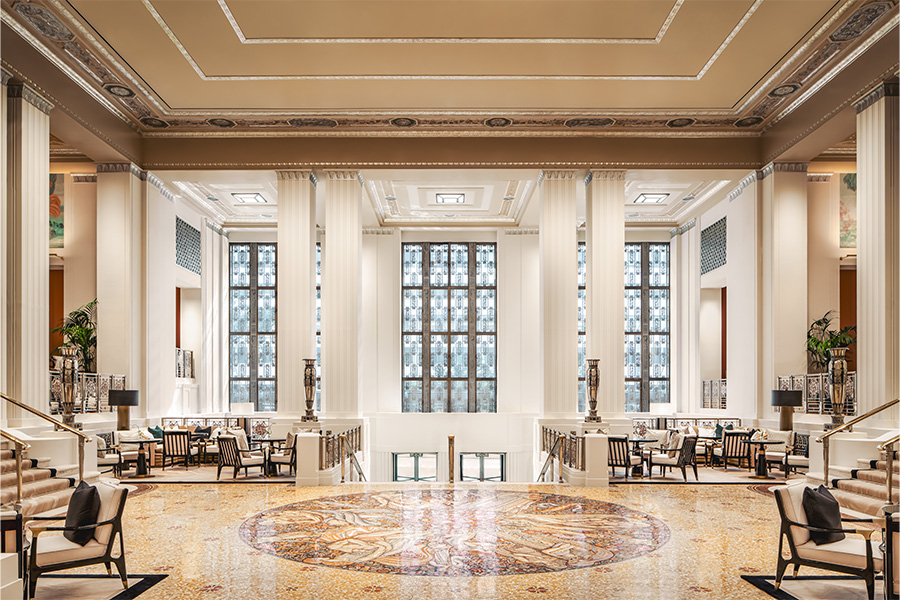
Louis Rigal’s refurbished Wheel of Life tile mosaic continues to grace the floor of the Park Avenue foyer
Fusing these two components was a gargantuan task, involving numerous craftspeople, like the artisans who made replicas of damaged decorative spandrels and the conservationists who gave new life to the 16 Edward Emerson Simmons murals adorning the Silver Corridor.
Guiding SOM’s approach to the 1.6-million-square-foot WANY were the specification book, renderings, and drawings uncovered in Schultze & Weaver’s archive. Those treasures helped Mahan and his team choose between the preservation, restoration, and adaptive reuse of elements throughout.
The hotel’s exterior and 62,000 square feet of interiors—only four percent of the building—are landmarked and required special attention. Nearly 6,000 windows were removed, for example, and replaced with high-performing aluminum-framed ones that stay true to the original paint color and slim steel dimensions.
Inside the Park Avenue foyer, Louis Rigal’s mosaic tile floor and wall murals gleam once again, buoyed by a softly lit restored marble panel revealed in the archives. “It had been lost for so long, we’re practically creating something new,” points out Mahan.
For the fish motif carpet, a reinterpretation of the Persian-style one that formerly dressed WANY, now gracing Peacock Alley bar, Claire Mabon, principal and senior design director at Paris- and Chicago-based PYR, relished the research process. “It was interesting to recreate something not as a pastiche but an inspiration of the past,” she says.
Complex Transformation
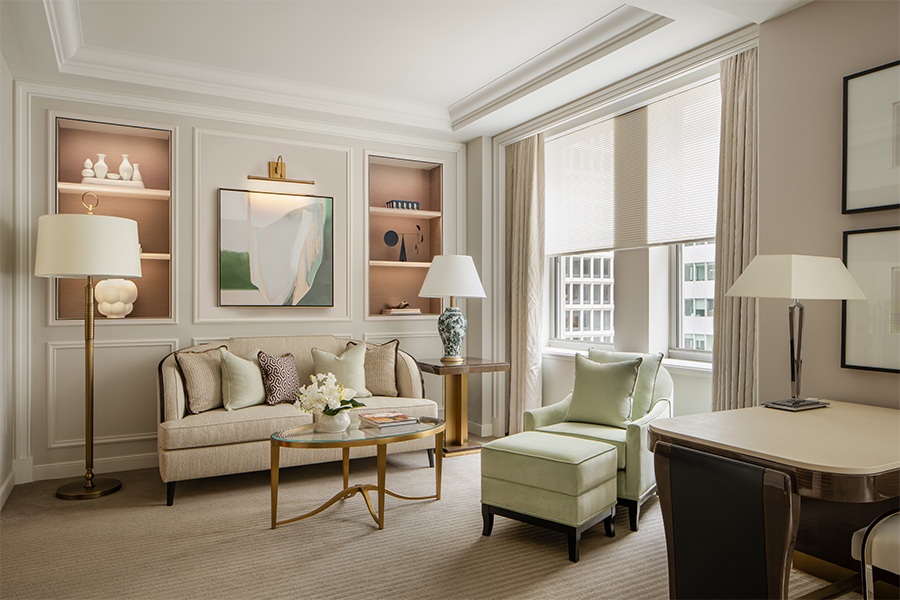
A spacious seating area and stellar views are highlights of the Park Avenue junior suite
Those who had visited the old WANY will notice remarkable changes immediately. The reception area is now discreetly positioned away from the central lobby, the heavy wood paneling and oppressive 1950s frieze were dismantled, and the sequence of public spaces was choreographed to honor Schultze & Weaver’s vision of a harmonious enfilade.
One of the most significant alterations is the reduction of the 1,400 guestrooms to 375 commodious keys (there are also 372 residences designed by Paris-based Jean-Louis Deniot). “Going from 1,400 to 375 means a completely different hotel, a different clientele,” says Pierre-Yves Rochon, principal and global design director at PYR. “That was the beginning of the design for us. What should the Waldorf Astoria New York be?”
Ultimately, PYR decided the hushed accommodations should feel residential, evocative of true New York apartments. There are curving headboards, walk-in dressing rooms, and subtly integrated mirrors that cast the illusion of double windows, simultaneously bringing Park Avenue in. Details from doorknobs to bespoke furniture also showcase “the DNA of the 1930s that wasn’t there before,” Rochon says.
Next Chapter
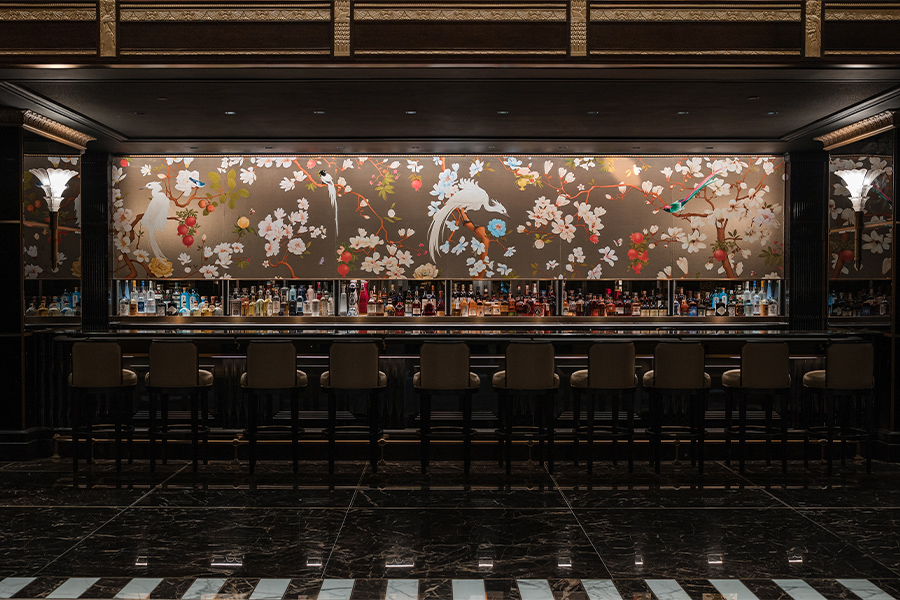
A bar crafted from black lacquer and Saint Laurent marble entices guests into Peacock Alley
For decades, the lobby was dark and chaotic. Now it’s a place to linger amid walls refinished in maple burl veneer and a refurbished plaster ceiling and black marble columns. “We needed to respect the architecture,” points out Rochon, but “we also wanted to give life back to the public spaces.”
Drinks at Peacock Alley are a draw, as is Lex Yard, the restaurant helmed by chef Michael Anthony in the re-expanded East Arcade. For the two-story space, AvroKO’s New York office delved into the Art Deco movement, melding stepped forms with materials like lacquered wood, velvet, and brass.
To ensure the view of the bar from Lexington Avenue wasn’t blocked, pendants were swapped for a coffered ceiling, “which creates a stunning, glowing canopy over the ground floor,” says AvroKO partner and cofounder William Harris. “Another striking feature is the bold double-height terracotta-upholstered wall hugging the staircase, paired with a dramatic chandelier inspired by the textures and energy of New York.”
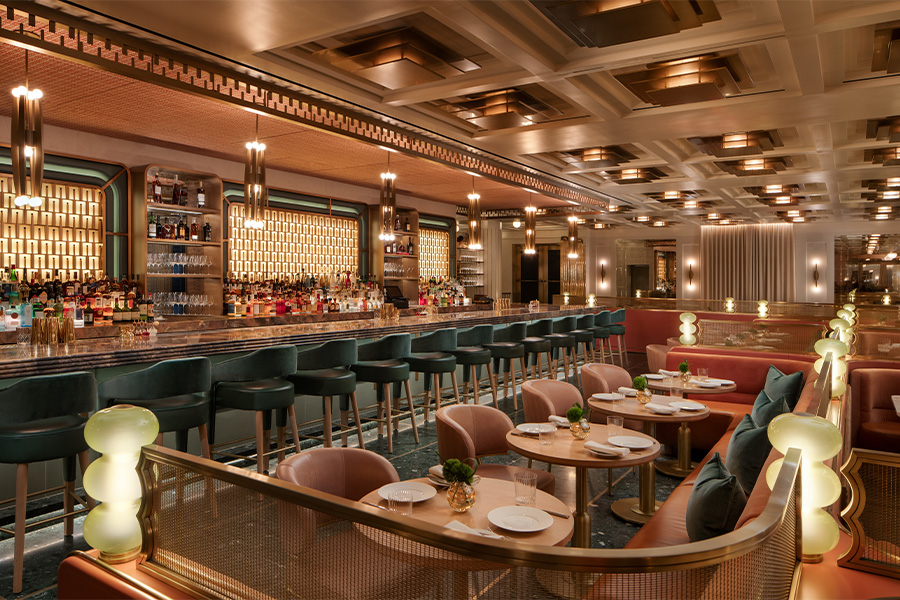
A coffered ceiling is the star of the AvroKO-designed Lex Yard, a two-story ode to Art Deco
The forthcoming Guerlain Wellness Spa, complete with a snow cave and Moroccan steam room, is also poised to animate WANY. The New York office of Wimberly Interiors pulled from both Art Deco geometry and Parisian glamour for the design. “The interplay is most apparent in the flow of the spa, where clean lines and sculptural silhouettes honor the building’s Deco character, and lighting, furnishings, and custom millwork reference the artistry of Parisian ateliers,” points out Liana Hawes Young, the studio’s associate principal and creative director.
WANY was a huge undertaking “and it required a massive amount of coordination. As owners, practicality had to anchor every decision. It was a constant balancing act of precision and perseverance,” explains Walsh. “Watching people walk from Park Avenue to Lexington, it’s almost like the original Peacock Alley, with women parading through and showing their gowns. It’s beautiful we captured that again.”
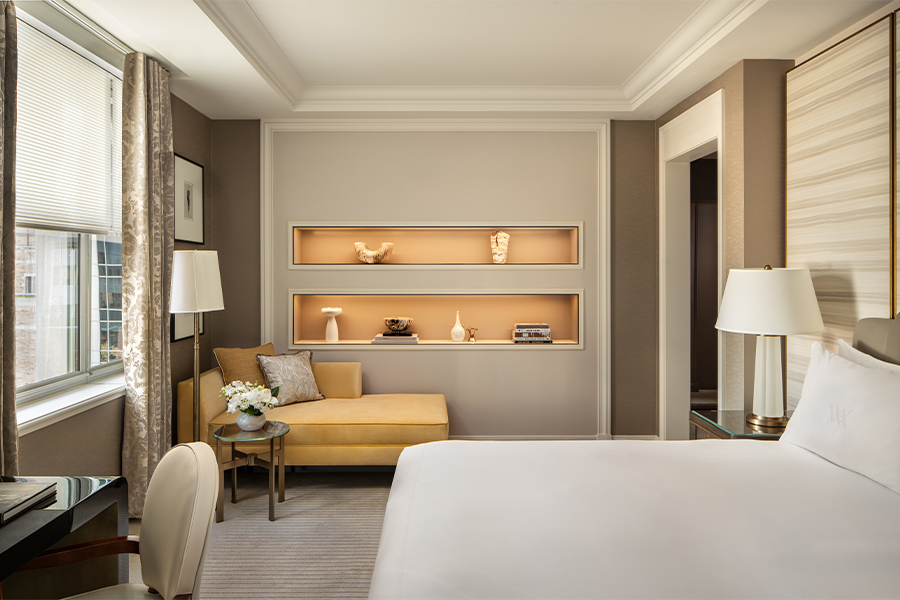
Shelves brightened with objects lend a homey feel to the premier one-bedroom suite
This article originally appeared in HD’s October 2025 issue.