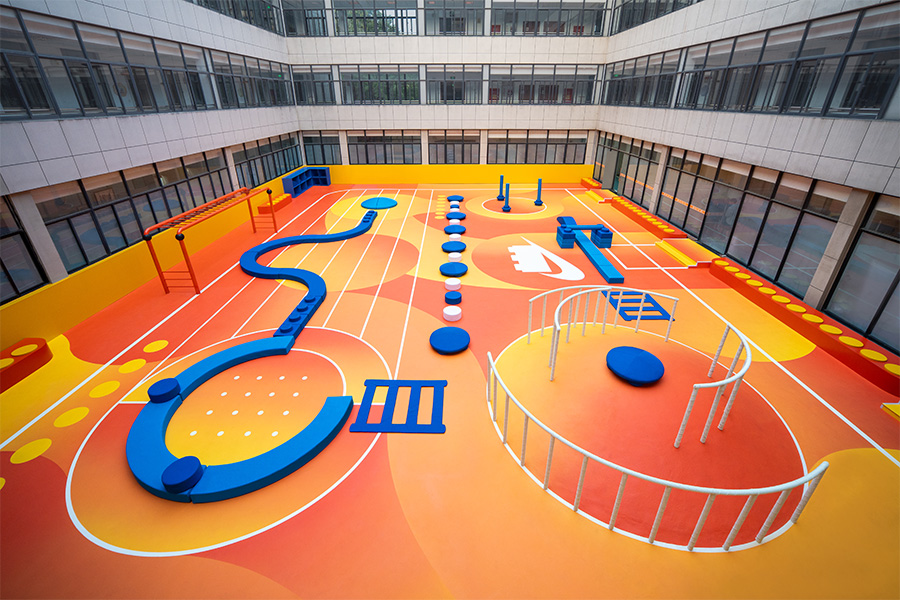
Nike recently partnered with LEGO on a schoolyard project at Baoshan No. 2 Central Primary School in Shanghai, collaborating with design studio OLA Shanghai to transform the outdoor space with a bright gradient orange palette and bold cobalt blue modular structures inspired by the 2×3 LEGO brick. It allows children to experiment with space and create their own play experiences, demonstrating how such design interventions can support not only educational but also emotional and creative development.
Increasingly, schools are rethinking spatial design with a focus on emotional wellbeing and sensory engagement. Here, three recent projects show how thoughtful design can impact the way children learn, explore, and connect.
Fulnek Kindergarten
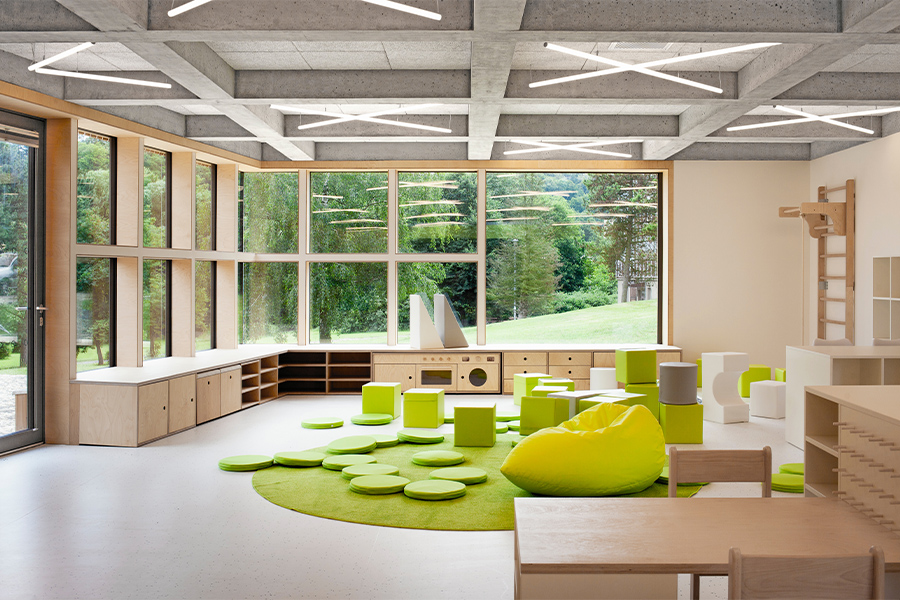
A classroom in Fulnek Kindergarten in the Czech Republic opens to views of the surrounding landscape
Nature drives the design of a kindergarten by Prague-based studio XTOPIX in Fulnek, Czech Republic. The architecture embraces the surrounding terrain and draws inspiration from the town’s historic castle across the hillside. Two courtyards curve with the land, creating inlets where building and nature meet, ensuring every classroom—despite being part of a two-story structure—has access to the outdoors. The southern façade opens toward the landscape, while expansive windows and skylights draw natural light into the interiors. “Children spend much of their day immersed in a strong relationship with both the generous garden and the castle view, fostering an intuitive sense of belonging to their hometown,” says Pavel Buryška, cofounder of XTOPIX.
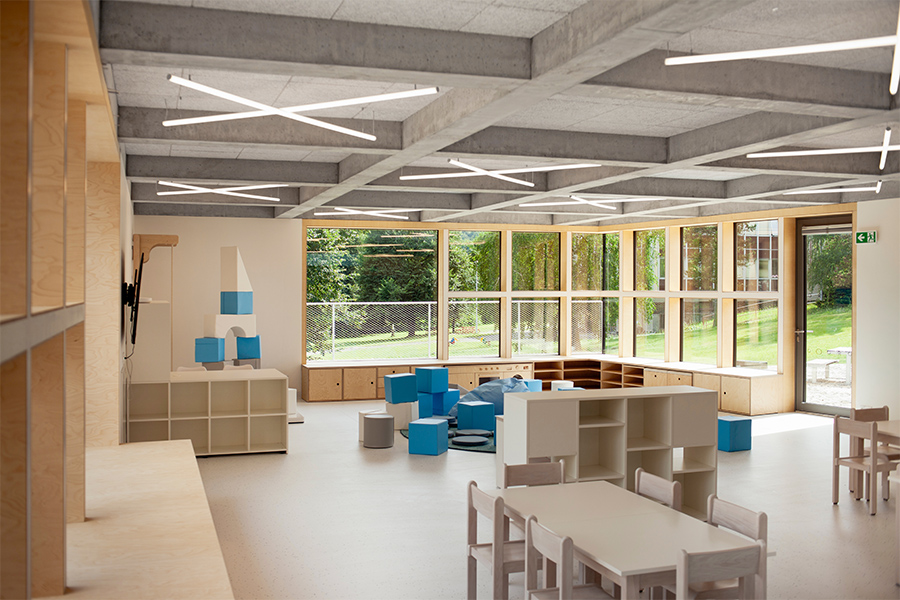
Each classroom in Fulnek is assigned a distinct color, making wayfinding easier for children
Inside, the modular layout creates activity zones like an art studio, kitchenette, theater corner, and craft workshop. A palette of wood, concrete, and glass, meanwhile, is punctuated by distinct colors—drawn from local flowers—in each classroom to support navigation. “Our primary approach to shaping the atmosphere was through natural materials, even in their raw form, so that children could develop an intuitive understanding of the materiality of construction itself,” Buryška says.
A key feature was involving children in the design process. Working with a graphic and type designer, the firm organized a workshop that led to a custom kindergarten font and signage system. “The children can one day tell their own children that they literally signed their names into the building’s authorship,” Buryška adds.
VIA Kindergarten and Elementary School
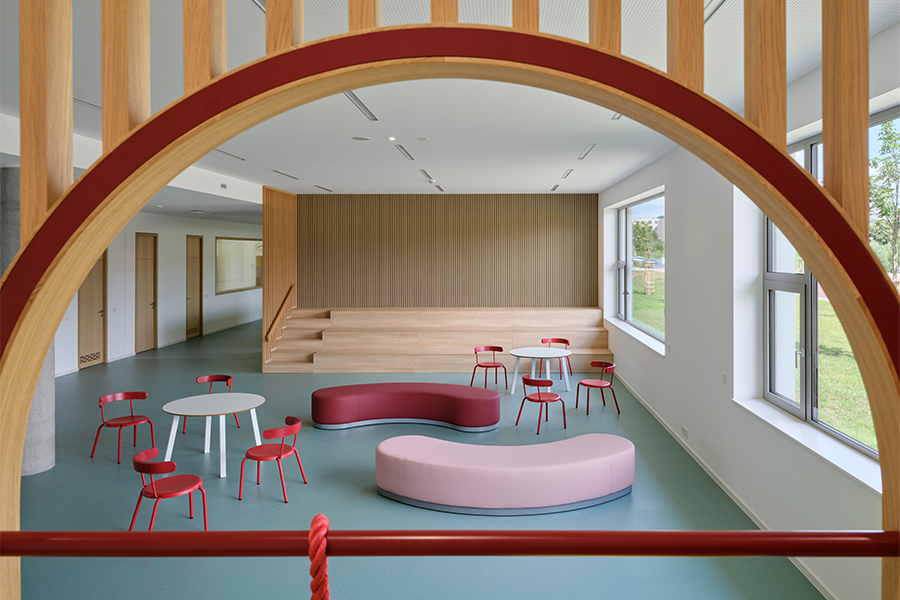
A curved seating area at the VIA Kindergarten and Elementary School in Beroun, Czech Republic
Also in the Czech Republic, the VIA School in Beroun transforms a former textile factory brownfield into a kindergarten and elementary school. The U-shaped building nods to its industrial past through a façade clad in perforated corrugated metal, echoing textile patterns once produced onsite, while large concrete elements appear in cornices, benches, and a bicycle canopy.
Though the school rises three stories, terrain modeling makes the volume feel smaller. “We adopted this strategy to integrate the building sensitively into the surrounding urban fabric and ensure it does not dominate the neighborhood,” says Jiří Opočenský, architect and cofounder of Prague-based OVA.
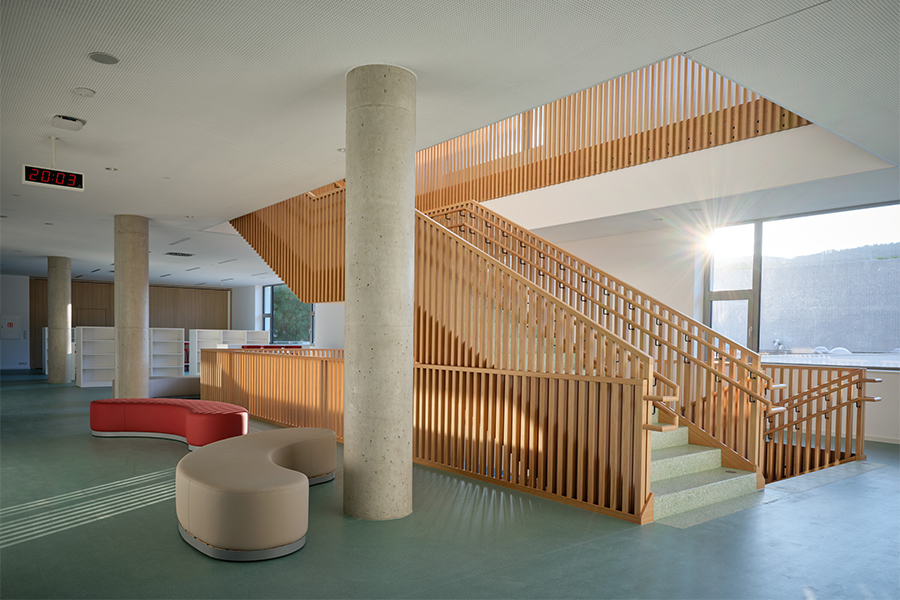
Transitional zones at the VIA Kindergarten and Elementary School are designed to encourage play
To soften the industrial character of the building, greenery was added in a lush courtyard, an educational garden, and a playground that extends into a grassy slope. Green roofs and window planters further reinforce the school’s connection to nature, with glazing providing expansive views.
Inside, the spatial flow encourages play and orientation. “From the beginning, we aimed for intuitive movement throughout the building,” notes Opočenský. Classrooms, a multifunctional hall, cafeteria, and an outdoor classroom branch from a central main hall, and even the corridors are designed for learning. With restrained materials like wood and terrazzo flooring, the spaces become adaptable, playful, and calm all at once. “A well-designed school is not just a place for instruction,” Opočenský adds. “It’s an everyday environment that deeply influences children’s overall experience.”
African Flow
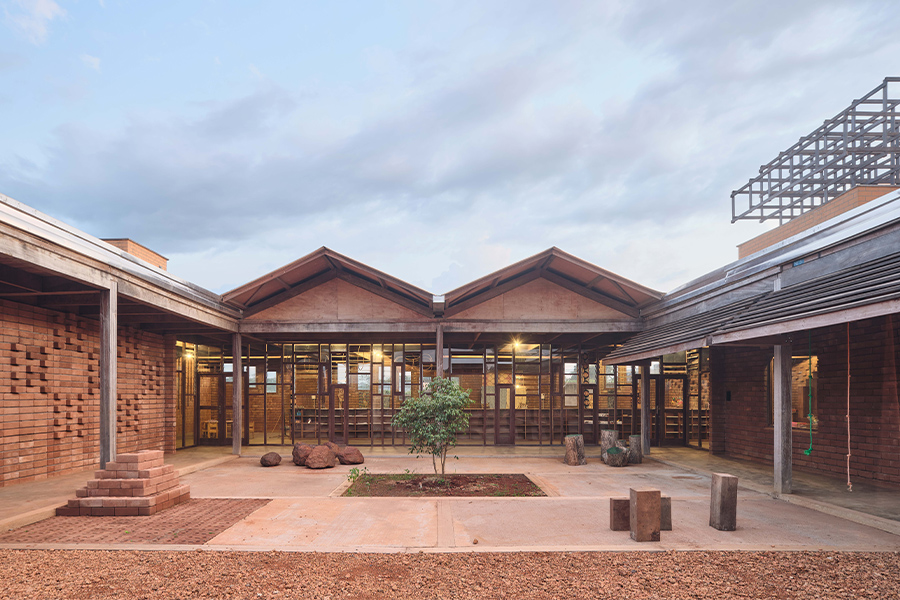
In Cameroon, the African Flow School is organized around a central courtyard that links four distinct learning ecosystems
“Architecture shapes the way we perceive ourselves and others. For children, space is the first teacher,” says Vicente Guallart, cofounder and principal of Urbanitree, a design and research studio with offices in Barcelona, Boston, and Shenzhen. His team recently completed African Flow, a kindergarten in Cameroon centered on ancestral African architectural principles.
The school is organized around a central courtyard and divided into four interconnected ecosystems. The Mountain includes a grotto for introspection; the Village fosters social interaction; the Savanna offers a linear gathering space reminiscent of learning around a campfire; and the Forest bridges indoors and out, complete with a constructed tree beside a small natural woodland. “Together, they create a geography that feels both familiar and symbolic for the students,” explains Guallart. “This flow between guidance and discovery mirrors the process of education itself—anchored in belonging, yet open to the unknown.”
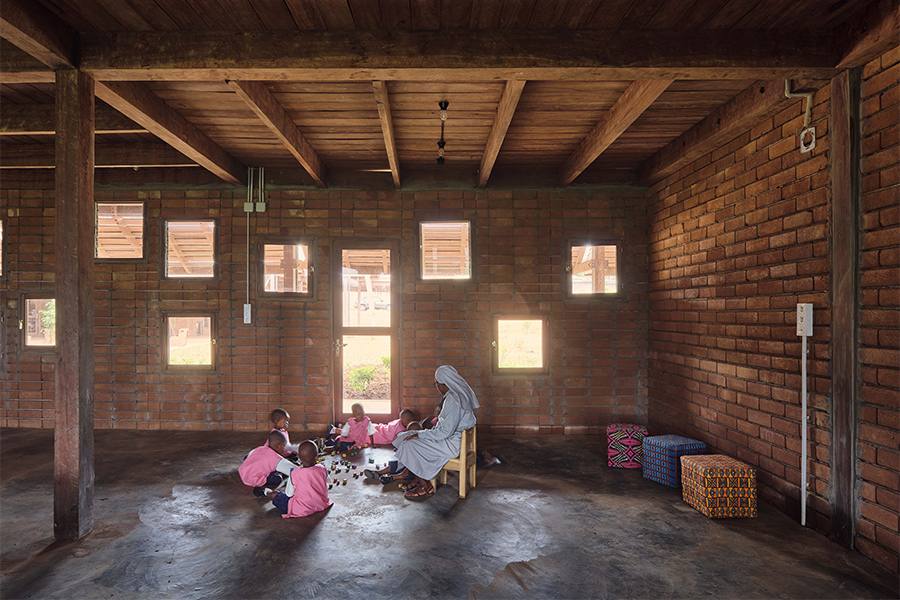
Classrooms at African Flow are built from local wood and rammed earth, rooting students in a familiar material environment
Local materials, including azobé, a termite-resistant wood; rammed earth; and tropical hardwoods like iroko, sapele, doussie, and movingui root the school in place. As a European team working in Africa, “it was essential that the project was not a transfer of knowledge from Europe to Africa, but a dialogue,” says Guallart. “As European architects, we learned to slow down—to observe how materials are sourced, how climate dictates form, and how construction becomes a collective act involving the community.”
The outcome is a school that is true to the land and its people. “We want them to feel that the school is theirs—that it is a natural extension of their lives and culture,” Guallart says. “The spaces are designed to be open, breathable, and tactile, inviting children to touch the walls, play with light, and feel protected yet free.”
He adds, “When children grow up in such environments, they learn that knowledge is not confined to walls but part of the life itself.”
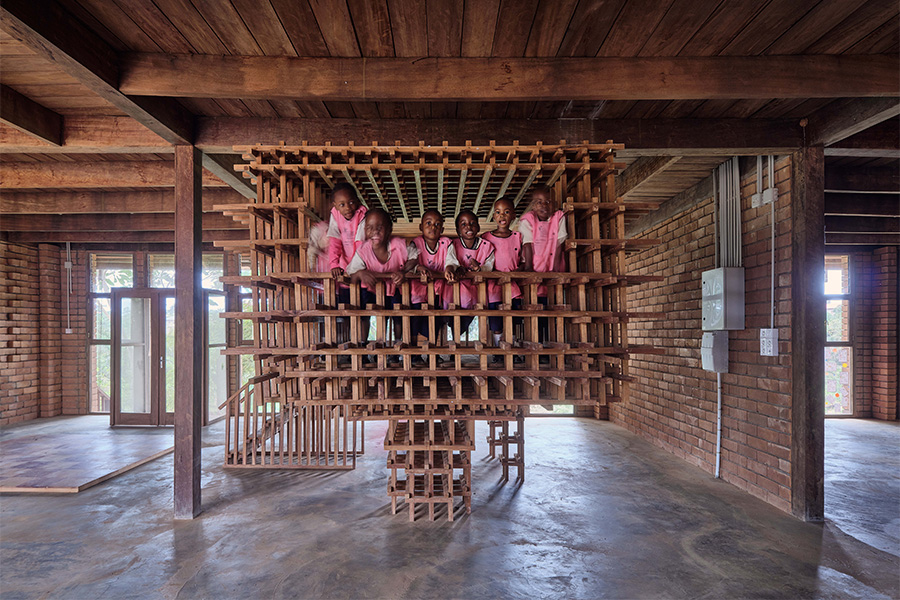
The Forest at African Flow is a transitional space that features a constructed tree similar to a Lego structure
This article originally appeared in HD’s December 2025 issue.