
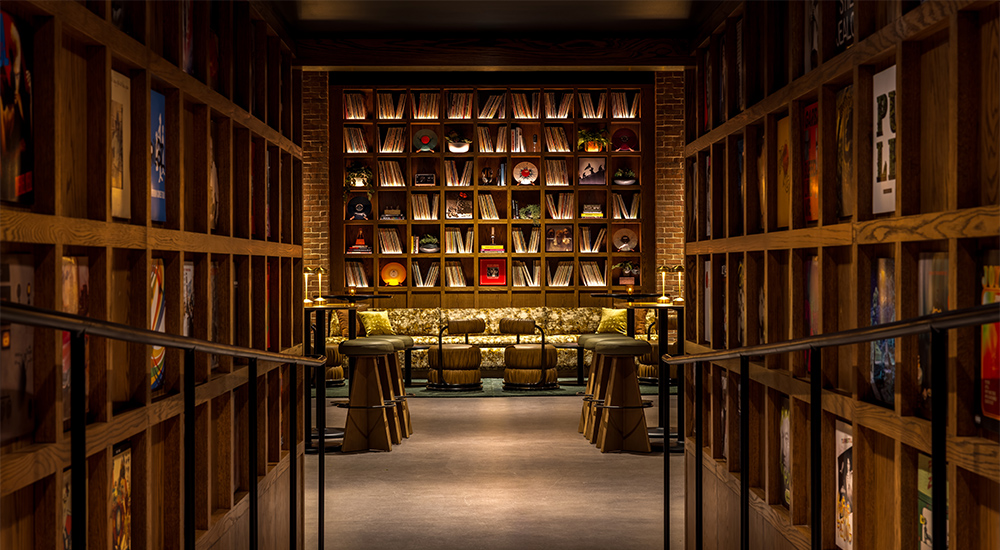
As vinyl continues its resurgence, a new typology is emerging across hospitality: the listening lounge. Designers are carving out intimate spaces where music shifts from background ambiance to the main attraction, often drawing inspiration from Japan’s jazz kissa—listening cafés where high-fidelity sound and focused listening have long shaped social gathering.
For designers, the shift is prompting a reconsideration of how sound, seating, and spatial flow shape social experience. At the recently opened Hotel Saint Augustine in Houston, for example, the Listening Room is tucked within the Augustine Lounge just off the lobby. Anchored by a reel-to-reel tape deck and turntable, the space pairs analog sound with vintage furnishings and an extensive vinyl collection, inviting guests to linger and engage more deeply with music.
Here, we explore four bars, lounges, and social spaces that have been reimagined by the shared ritual of listening.

Vinyl Room at Hollywood Palladium
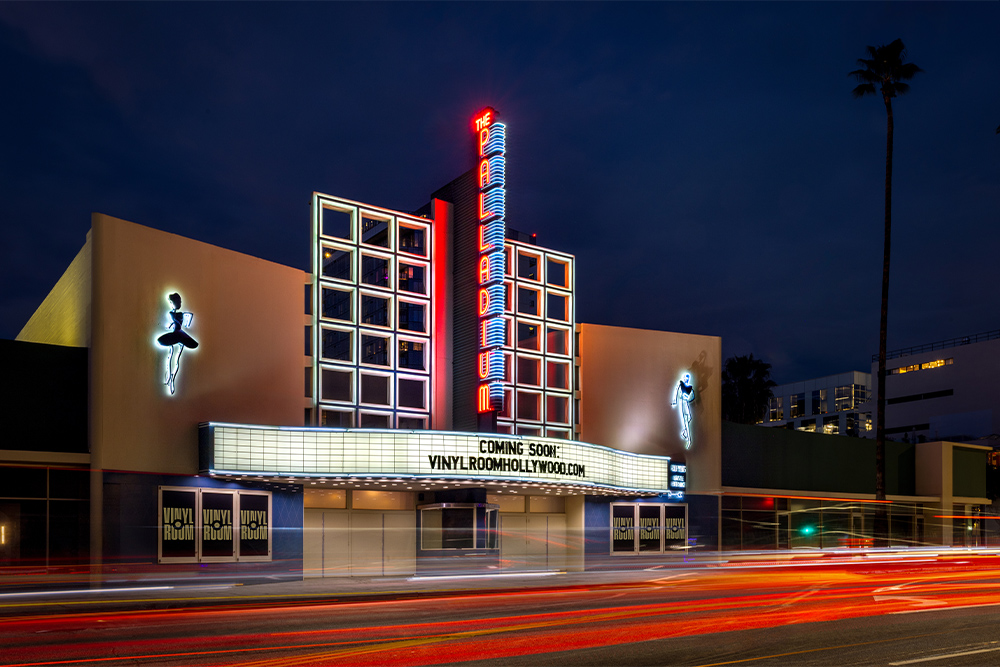
Photo by Evan Joseph Studios
Tucked into a once underutilized corner of the historic Hollywood Palladium, the Vinyl Room offers an intimate counterpoint to the venue’s high-energy concerts. Designed by Los Angeles-based Studio Collective in collaboration with Live Nation’s Blueprint Studio, the lounge draws inspiration from Japan’s listening bar tradition and the hi-fi boom of the 1960s and ’70s, creating a space dedicated to analog sound and listening.
Guests enter through an understated alley doorway and proceed down a dim corridor lined with vinyl displays that opens onto the main lounge. At its center, a curving bar—shaped like an LP—anchors the room. Custom millwork integrates high-fidelity speakers, vinyl storage, and a DJ booth into the bar itself, accommodating specialized audio equipment while maintaining clear sightlines across the room. The result blends minimalist detailing with residential comfort, positioning the lounge as both a listening destination and a social hub connected to the Palladium’s live music programming.
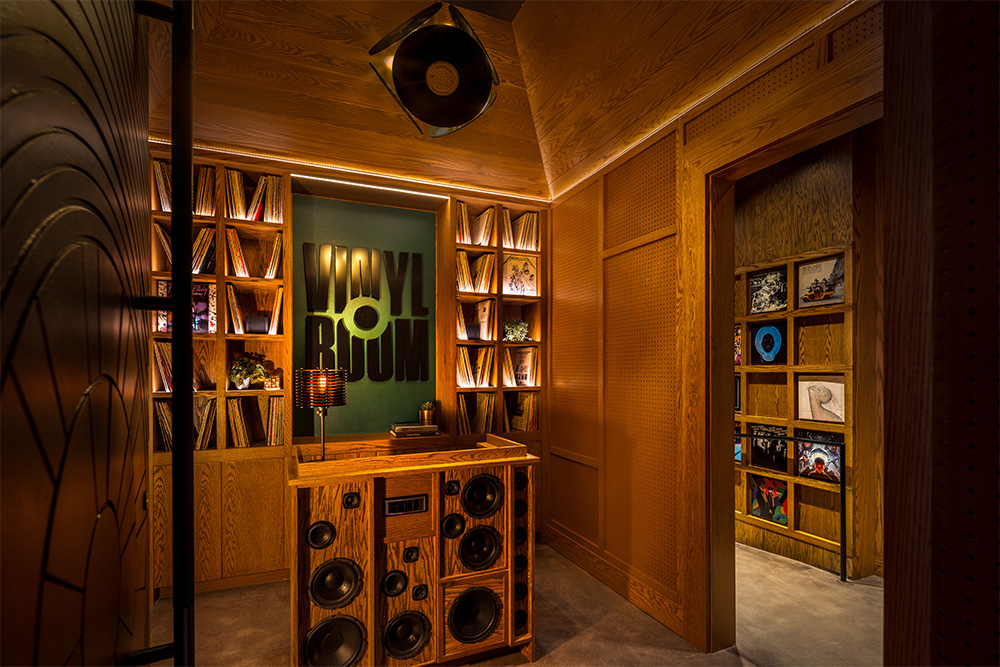
Photo by Evan Joseph Studios
“It was very exciting for us to develop this new concept with Live Nation and Blueprint Studio,” says Studio Collective design director and partner Adam Goldstein. “The Vinyl Room is intended to be a true audiophile sanctuary rooted in each venue’s history. Unlike other listening rooms, it’s designed to both stand alone as a dedicated listening space and complement existing Live Nation venues, allowing guests to experience the rush of live performance alongside a more intimate audio environment.”
Adds Ruthie Embry, senior vice president of architecture and design at Blueprint Studio: “Our fans’ connection to music and the rich history of our venues is at the center of everything we do. Each Vinyl Room builds on a shared design foundation while celebrating the music history that defines its community.”
Anima
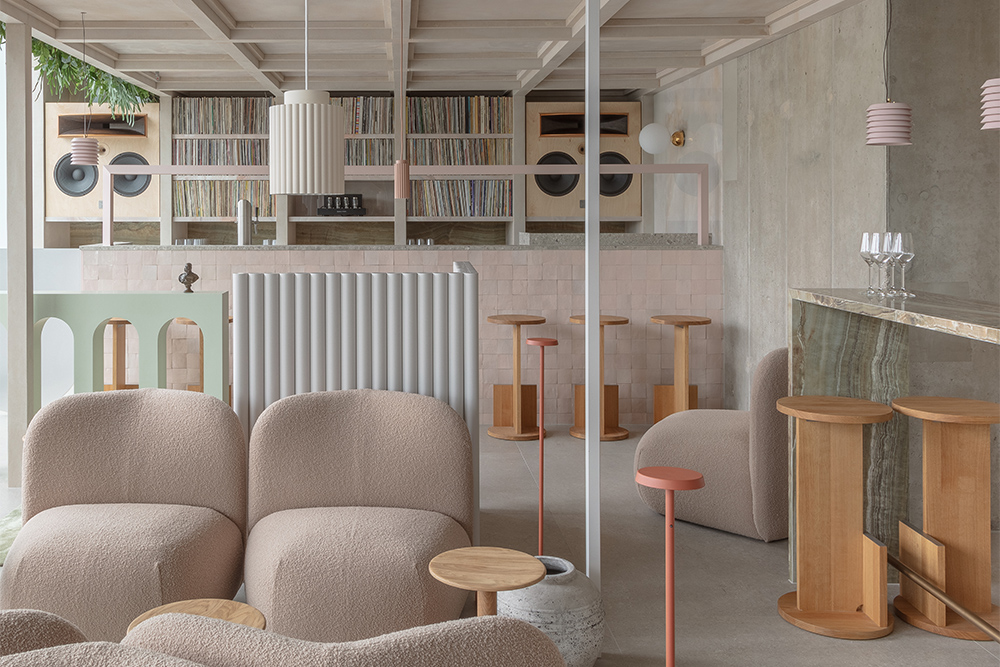
Photo by Nicholas Worley
At Locke at East Side Gallery in Berlin, listening bar Anima anchors the hotel’s ground-floor social spaces. Designed by New York-based Grzywinski+Pons, the café, lounge, and vinyl-focused bar sit at the heart of the 176-room property, positioned alongside the longest surviving stretch of the Berlin Wall—now transformed into the vibrant East Side Gallery.
The design responds to that layered history. Conceived as a liminal space for exchange, the ground floor connects the city to the Spree river through an opening in the wall itself, weaving reception, café, lounge, and listening areas into one fluid environment. “We treated these social spaces as a microcosm of Berlin itself,” says Matthew Grzywinski, principal of Grzywinski+Pons. “There are no restrictions to visibility, access, or circulation, and the entire level presents itself as a legible whole.”
Within Anima, architectural details organize the interior into more intimate zones. Fluted partitions, ombré curtains, and warm materials soften the concrete shell, creating a convivial setting where guests gather around music, conversation, and shared cultural exchange.
Stylus
Rendering courtesy of O’Neill Rose Architects
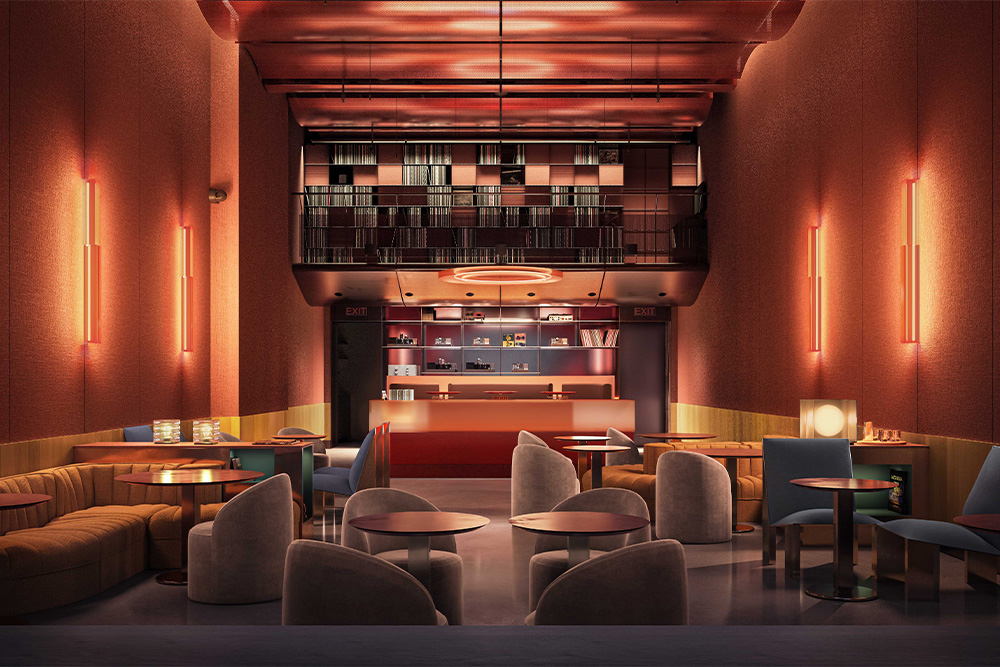
Opening on New York’s Lower East Side this fall, Stylus reimagines the traditional members club as an acoustic salon dedicated to deep listening. Designed by Brooklyn-based O’Neill Rose Architects, the project transforms a former recording studio and Blue Man Group rehearsal space into a four-story environment built around sound, culture, and community.
At the heart of the club is Ephemeral, an acoustically engineered listening room and performance space where vinyl sessions, talks, and live performances unfold throughout the day. Sculptural speakers designed by Devon Turnbull of OJAS anchor the room, while a sophisticated spatial audio system by Amadeus Acoustics allows the space to shift its reverberation profile—recreating environments ranging from an intimate jazz club to grand concert hall.
The architecture reinforces this sensory journey. Visitors move through a sequence of progressively quieter spaces—from the energy of Clinton Street into increasingly refined interiors—before arriving at the dedicated listening space. “The design concept is rooted in the idea of exploration and destination, and acoustics play a central role,” says Devin O’Neill, cofounder of O’Neill Rose Architects. “As you move through the building, the spaces gradually become calmer and quieter, culminating in a sonic destination that calls attention to the experience of listening.”
Jam Record Bar
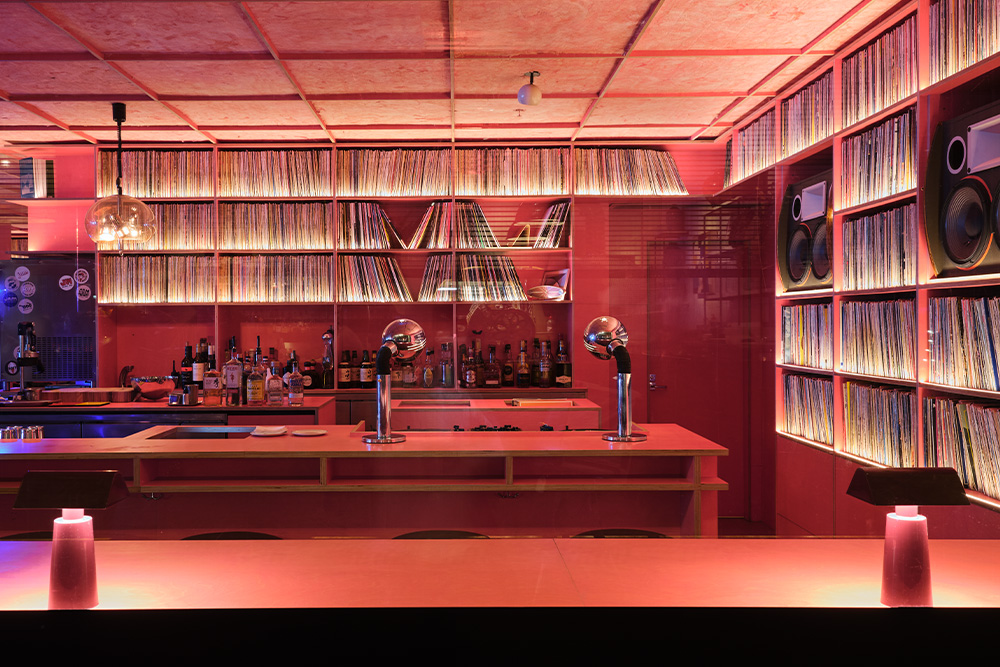
Photo by Tim Salisbury
In Sydney, the concept takes a more intimate form. Jam Record Bar channels the spirit of Japanese listening bars in a compact setting. Located on George Street, the 45-seat venue, home to a collection of more than 15,000 vinyl records, pairs curated music with Japanese-inspired snacks and cocktails.
Designed by locally based Akin Atelier, the interiors take cues from the architecture of sound itself. Wrapped in plywood, cork, and pink insulation, the space is conceived as an immersive environment—similar to stepping inside a giant speaker box—where acoustics and atmosphere are inseparable. “We wanted the bar to feel simple and analog but also refined,” says firm principal architect and design director Kelvin Ho.
Retro lighting and styling objects add warmth to the otherwise stripped-back palette, while the room’s compact scale keeps the focus firmly on the music. Together, these elements form an intimate venue where vinyl culture takes center stage and sound becomes the main event.
This article originally appeared in HD’s April 2026 issue.