
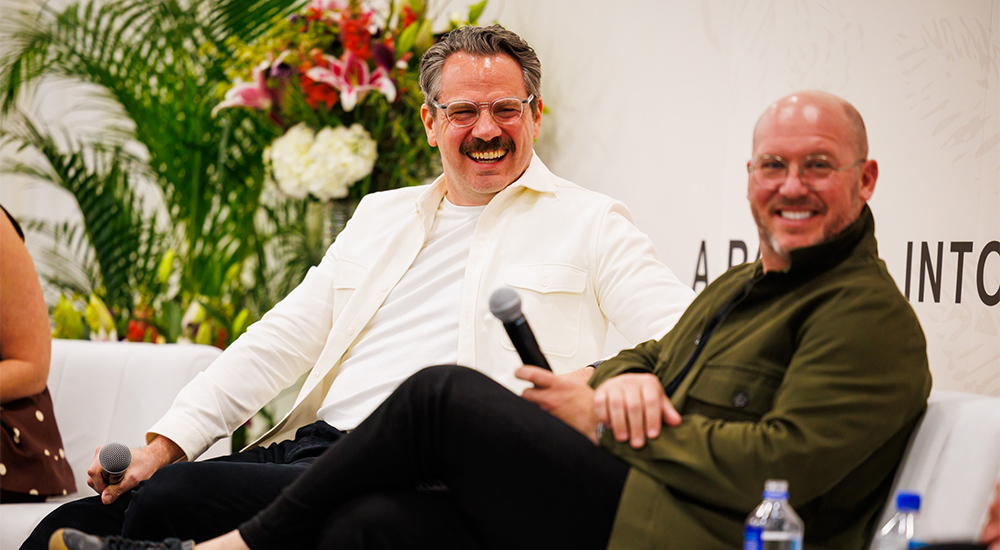
From wellness as a continuous experience to cinematic guest journeys, Desert Rock’s site-driven luxury, and the realities of running a firm, day one of HD Expo spotlighted how hospitality design is expanding beyond aesthetics.
1. Wellness is the design baseline, from hotel to home
Wellness is no longer confined to the spa, the gym, or the healthy dining option—and it is no longer confined to the hotel, either. During Wellness by Design: Seamless Technology Experiences from Hotel to Home, panelists framed hospitality as both a setting for wellness and a testing ground for the tools and sensory cues guests may later seek out in their own homes. “Wellness design and technology used to be something that we would see in very prescriptive kind of spaces,” says Glenn Nowak of UNLV. “The spa is the place where you go for wellness, or the gym is where you go for wellness. Now, design decisions in all spaces throughout hospitality have elements of wellness.”
Panelists pointed to in-room fitness, lighting, scent, soundscapes, and customization as examples of wellness moving across settings. Sherrie Tennessee of SpaSOS notes that wellness is being “wrapped into every aspect in residential as well as commercial,” while RH’s Kaylee Barnett describes hotels as places where guests can be inspired to bring wellness practices home.

Technology is central to that bridge, but only when it feels integrated rather than imposed. As hotels introduce massage chairs, red light therapy, immersive projections, sound-mitigation tools, and data-informed personalization, panelists cautioned that wellness tech should reshape the surrounding environment instead of simply occupying space within it. “Any new equipment that is geared toward wellness ought to have a ripple effect where elements around that equipment, begin to change in their design,” Nowak says. “If it’s just a plug and play, you’ve missed a huge opportunity to really rethink the design.”
2. The guest journey is being choreographed
During The Choreographed Hotel: Cinematic Design for Evocative Guest Experiences session, panelists discussed hospitality design through the lens of cinema, dance, theater, and F&B service, describing memorable spaces as sequenced rather than simply styled. Arrival, compression, release, corridors, elevator lobbies, ambient sound, scent, lighting, and sightlines can all become tools for moving guests physically and emotionally through a narrative. Rather than treating transitional areas as secondary or purely functional, designers can use them to build anticipation, frame views, and carry the story from one space to the next. “The poetry is really in those transitions—that’s where you have the opportunity to really do something special,” says IHG’s Rebecca McBride. “And it doesn’t necessarily need to be a big spend, but it needs to be thoughtful, and there needs to be some intentionality behind it.”
That choreography also allows for a balance of planned and unplanned moments. Panelists noted that hospitality spaces can guide guests through a designed sequence while still leaving room for discovery, curiosity, and unexpected encounters. As Rockwell Group’s Katiana Rousseau notes of some of the firm’s restaurant projects, “there’s a little bit of scripted and unscripted magic that happens—from different thresholds of framing moments, to a feature open kitchen, or a small nook in the corner of the best seat in the house.”
3. The future of luxury may be more contextual, restrained, and risk-tolerant
In the Carved From Stone: The Story Behind Desert Rock session, architect Chad Oppenheim and designer Paolo Ferrari presented the Saudi Arabia resort as a case study in a more contextual, restrained, and risk-tolerant vision of luxury hospitality—but also one grounded in deep technical discipline. Rather than creating a resort that sits on top of the landscape, the team sought to make the architecture recede into it. “So, our work is really considering the idea that we’re not building on the land, but we’re building with the land,” Oppenheim says. That philosophy shaped a design language rooted in rawness, imperfection, and restraint, with the project’s power coming not from visual excess but from its relationship to the ancient rock formations of the Hejaz Mountains around it.
The panelists also emphasized that boldness depended on more than a strong concept: It required years of client alignment, technical coordination, and input from geologists, engineers, mining specialists, life-safety experts, and other consultants to turn a risky idea into a functioning luxury resort. As Ferrari notes, hospitality designers increasingly have to resist “this anyplace, homogenous kind of approach,” and Desert Rock proved that the most ambitious projects require both vision and restraint.
4. Creative leadership requires business fluency, not just design vision
The conversation shifted from design vision to the realities of running a creative business during In the Principal’s Office: Words of Wisdom from Designers at the Helm. Panelists spoke candidly about the parts of firm leadership that are rarely taught in school, from pricing projects and tracking billable hours to managing trade accounts, sales tax, HR, finance, legal needs, and team culture. “What I always say to people is, be students of every part of the business as you’re working in different firms, because there’s a lot that I had missed and then had to teach myself,” says Goodrich’s Matthew Goodrich.
That business fluency, the panelists suggested, is not separate from the creative work—it is what allows the work, and the studio culture behind it, to become more sustainable. Several speakers emphasized the value of knowing when to bring in outside expertise and build a more balanced team. “Once our business started to have a really solid operational background and have a director of operations, director of finance,” Goodrich adds, “that’s when things actually started to go much more smoothly.” The panel also offered a more personal leadership lesson: Owning a firm becomes “a mirror” for a designer’s values, confidence, and blind spots, making leadership as much about self-awareness as creative direction.