
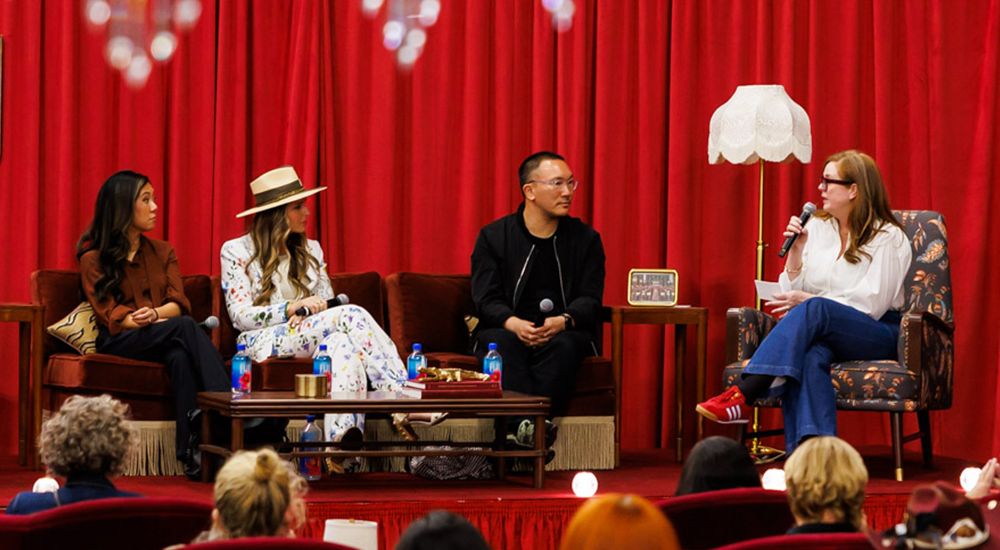
Wednesday’s conference sessions delved into how hospitality’s many facets come together to create an unforgettable guest experience. From sensory branding to legacy renovations, site-specific wellness, and the rise of private-club thinking, day two of HD Expo explored the ways hospitality design is becoming more emotional, more contextual, and more operationally precise.
1. Multisensory design is becoming brand strategy
Hospitality branding is no longer limited to logos, language, collateral, or even the look of a space. During the Hospitality as a Multisensory Brand Narrative panel, speakers framed brand as something guests experience through interior design, scent, lighting, branding, sound, materiality, touch, and the way those elements unfold together. “Every space you walk into is multisensory,” says Michelle Gagnon of Bio Alchemy Olfactive. “You’re going to see things, smell things, hear things, touch things, maybe taste things. So it’s really about having control and telling a cohesive story among those elements that enhance your brand.”
The same idea surfaced during the Private Club Effect: Amenity-Rich Living in Hospitality session, where panelists discussed how materials, lighting, scent, comfort, and durability all shape the emotional read of a space. For Colby Weaver Walker of InterMountain Renovations, the point was simple: “People remember how a space makes them feel.” In that sense, multisensory design is not an added layer; it is part of how a property communicates quality, belonging, and memory.

2. Site-specific design starts with listening, not imposing
During Site as Strategy: The Architecture of Wellness, panelists described site-responsive work as an act of restraint. Rather than arriving with a predetermined concept, designers must let the land, culture, climate, history, and guest journey shape the project. “Site-responsive design requires a lot of restraint more than anything else,” says 10 Design’s Jorey ‘Shosh’ Friedman. “You restrain yourself from pre-thinking what the project is going to be, so that you don’t impose buildings on it, but instead listen to what the site is telling you.”
That principle also applies to wellness programming. Jeanine Allpress Cliffe of TLEE Spas + Wellness described discovery as a process of getting immersed in the destination, from local art galleries and botanical gardens to indigenous plant life, local practices, and the competitive set. The goal, she says, is programming “that’s really aligned and in tune with the destination.”
3. Wellness is moving from amenity to atmosphere
Echoing points heard during sessions on day one, the Site as Strategy panel also pushed the concept of wellness beyond the spa. Panelists described it as something embedded in arrival, circulation, gardens, outdoor spaces, architecture, sensory cues, and programming. “Wellness is really moved from the idea of a four-wall spa at one section of the property to the entire immersive experience for the guests from the minute they arrive,” Allpress Cliffe explains.
That shift makes nature, sensory design, and sustainability part of the same conversation. Allpress Cliffe connected wellness to “decompression and detachment from all of our electronics,” while Friedman pointed to passive energy, circadian rhythms, and light as examples of sustainability and wellness becoming increasingly linked. “Over time, they’re just going to be one and the same, hopefully,” Friedman says.
4. Legacy properties derive value from memory, not uniformity
Restoring the Past, Designing the Future: Repositioning Legacy Hotels for Today’s Guest brought the conversation back to the business case for preserving what makes legacy properties distinct. Historic renovations can be more complex, more expensive, and more time-consuming than other property types, but panelists argued that their value often lies in what cannot be replicated. “There’s an inherent value that can’t be tabulated in a pro forma,” says Victor Schmick of Davidson Hospitality Group, pointing to the Grand Hotel on Mackinac Island in Michigan as a property tied to generations of guest memories. “We’re investing in intrinsic emotion,” he adds.
Liana Hawes Young of Wimberly Interiors echoed that balance in discussing the refresh of the Hotel del Coronado, where the team had to weigh operational needs, design intent, historic preservation requirements, and the memories of returning guests. “There’s a community behind what you’re doing,” she points out, noting that the project required “a lot of push and pull. The concept for Nine Orchard—a former bank building-tuned-hotel in Manhattan’s Lower East Side neighborhood—Mancini Duffy’s Jessica Sheridan says, was “to maintain a sense of place and to create the storytelling aspect of the experience,” including the fact that “every room is a little bit different.” The panel also addressed the friction between brand standards and historic DNA, with Schmick noting that adaptive reuse often requires “a heartfelt conversation with the brand about what’s actually going to drive rate.”
5. Creating a sense of belonging requires both emotional design and operational precision
The conversation around private clubs, lifestyle hospitality, fitness, and luxury environments during the Private Club Effect centered on belonging—and how deliberately it must be designed. “Belonging is alignment,” says Weaver Walker. “It’s whenever the programming and the design and the service all come together and they tell the same story.”
But belonging is not only emotional. It also depends on details that make a guest or member journey feel seamless. Equinox’s Andrew Lee described the importance of understanding the local member, the market, and the operational flow of a space, while JoyceLynn Lagula of PerkinsEastman noted that “the frictionless guest experience is key, and sometimes drive[s] your decision-making.” From parking and wayfinding to circulation, tiered access, and the first arrival moment, the panelists made clear that successful hospitality design depends on both feeling and function.