
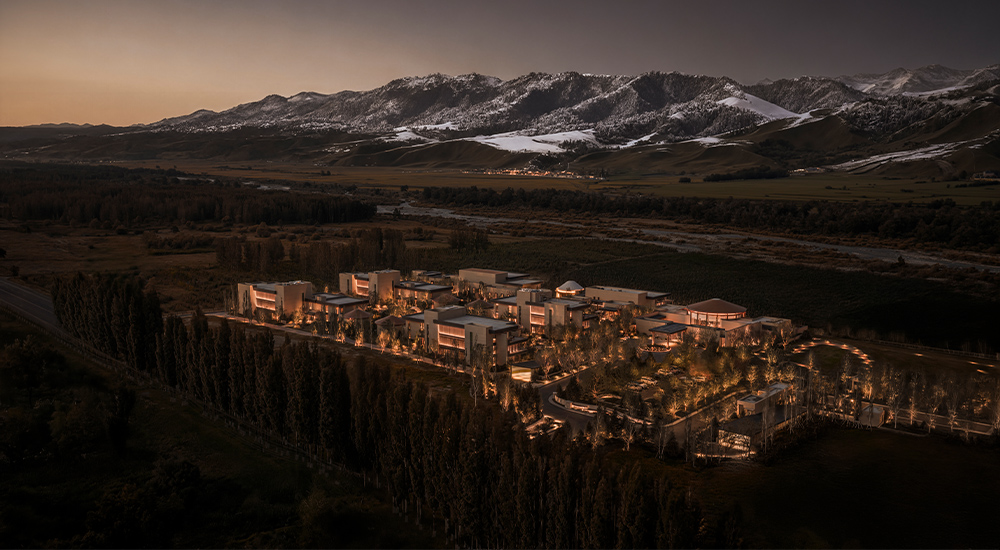
At the intersection of two of China’s most picturesque driving routes—the Duku Highway and the Ili “Figure-8” Scenic Loop—rests a new luxury respite for travelers. The Hotel Indigo Nalati, which lies in Nalati Town within the Ili Kazakh Autonomous Prefecture that borders Kazakhstan, Mongolia, and Russia, converges with the region’s vast grasslands and Tian Shan mountains beyond.
The goal for CCD/Cheng Chung Design was to create a hospitality complex that appears like a small forest when viewed from afar, with its master plan following the contours of the grasslands to minimize environmental intervention. Amenities and guestrooms are thus dispersed throughout the property, with individual low-rise structures gently tracing the terrain and connected by winding paths.
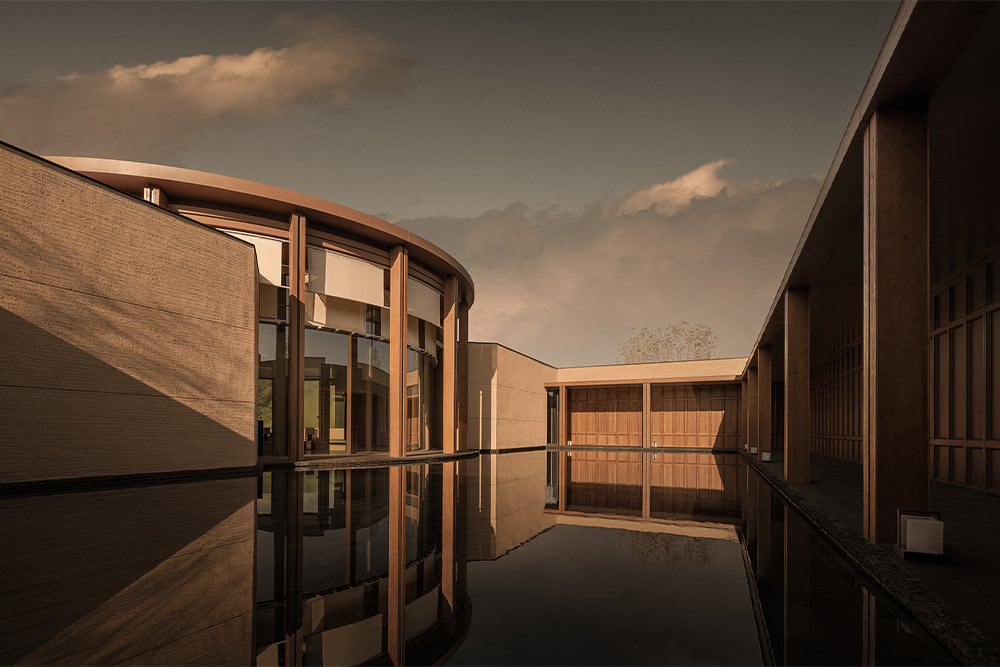
A reflection pool captures the open sky above, lending a quiet stillness to the courtyard
Another goal for the design team: honoring the region’s distinct cultural identity. Among the prefecture’s inhabitants are a high concentration of the nomadic Kazakh ethnic group. And so, CCD elected to weave the Kazakh concept of mausyn—which translates to “season”—into the hotel’s spatial narrative to capture the shifting rhythms of everyday nomadic life and Nalati’s four seasons. “The cycle of the seasons embodies the pulse of life on these grasslands,” says Joe Cheng, founder of the Hong Kong-based firm. “We envisioned the hotel as a spiritual waystation along a journey of exploration.”
Indeed, public spaces unfold like the passing of the seasons, taking inspiration from traditional local elements like yurts (circular, portable tent structures used by the Kazakhs) and winter settlements.

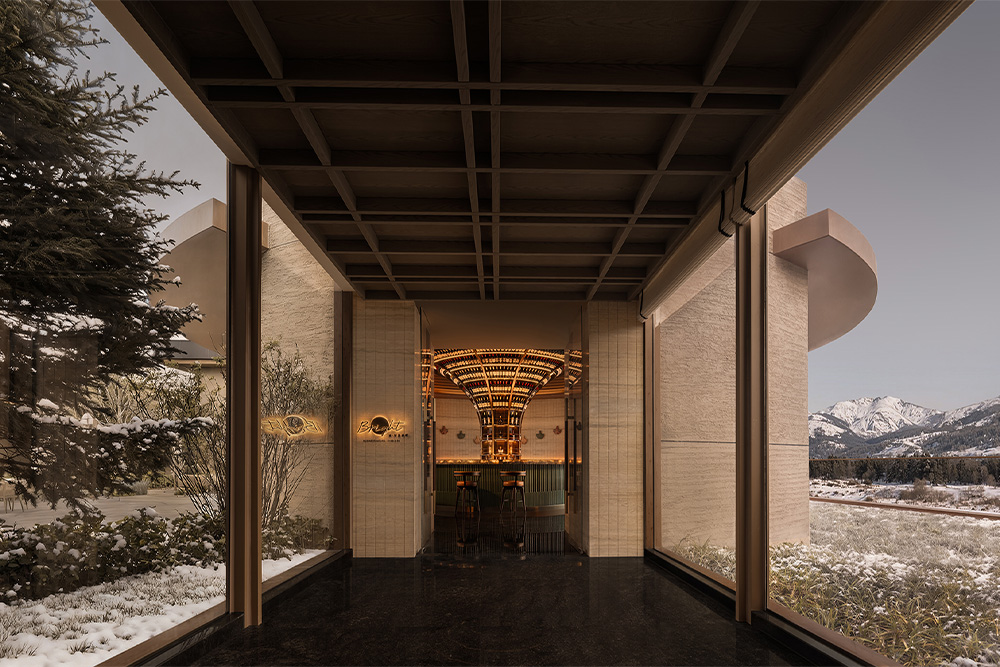
A glass-lined corridor leads guests toward the hotel’s restaurant, Show · A Neighborhood Café
The journey begins with the sunrise, as Nalati means “the place where the sun is first seen” in Mongolian. The entry’s curved canopy evokes radiating sunbeams and appears to float over the drop-off area. The soft curves and warm tones mirror the experience of stepping into an aul, a traditional Kazakh nomadic settlement on the grasslands. The adjacent courtyard is bathed in light, combining stone steps and wooden railings to create a relaxed arrival experience.
The story of a day’s light continues in the lobby via a skylight that interrupts the large-scale, yurt-like dome. The sun’s rays on the interior red brick walls shift as if following the footprints of migrating herders. Surrounding the skylight are layered, scale-like patterns that resemble thawing earth. Below, a sweeping, curved window frames the boundless view of the grasslands and mountains, while artwork crafted through local felt-thread techniques acts as the backdrop to the reception desk.
The highlight, however, is the hearth—a traditional firepit that makes the heart of the home in nomadic culture. Seating around this spatial centerpiece recalls Kazakh gatherings to share warmth, food, and stories on the surrounding terrain. “[The hearth] reflects a shift in modern luxury hospitality from material opulence toward warmth, intimacy, and cultural resonance,” Cheng says. “Luxury here is defined by a profound sense of freedom rooted in a deep connection with nature.”
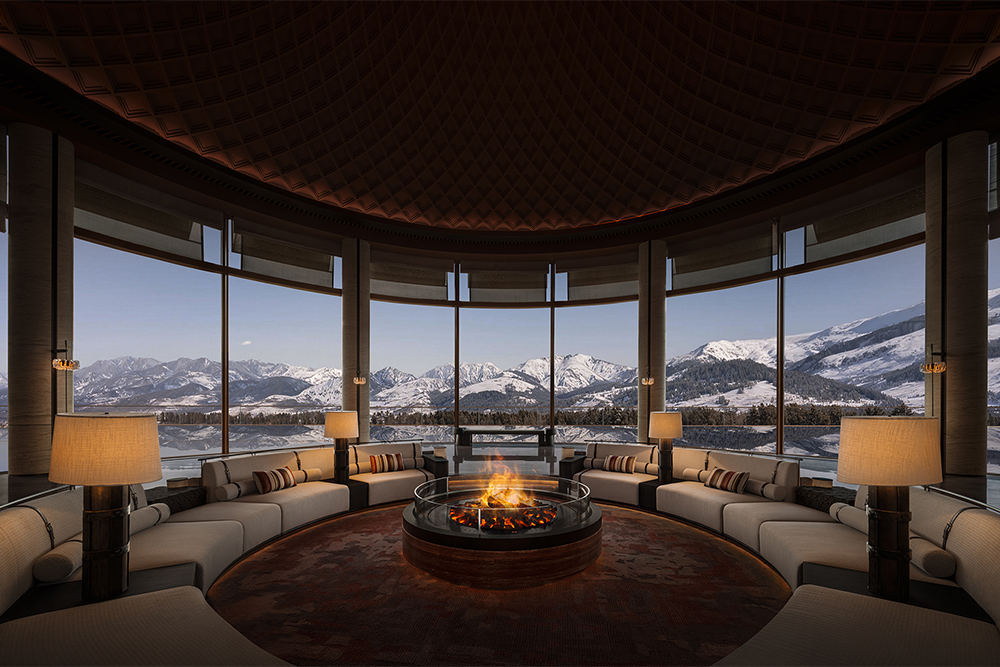
A central hearth, which recalls the communal rituals of nomadic life on the steppe, grounds the lobby
The restaurant, Show · A Neighborhood Café, further integrates guests into the natural surroundings. The circular bar evokes a solitary tree on the grasslands and introduces the space’s visual flow. Red bricks and washed stone finishes echo earth tones while warm wood and metal accents introduce a modern tactility.
As for the accommodations, light fixtures inspired by the Crocus alatavicus (the first flower that grows in spring in Nalati) guide guests from the elevator to their rooms. Pushing open the intricately carved double wooden doors, guests are welcomed by more natural light via a skylight that emphasizes walls as well as carpet that draws on the tradition of felt craft. Partitions and walls subtly reinterpret the local yurt’s diamond-grid wooden framework.
“We are most proud of how cultural heritage has been meaningfully integrated at every scale of the project,” Cheng says. “We hope guests leave not just with photographs, but a sense of inner calm born from communion with nature, respect for nomadic culture, and a renewed longing for freedom and movement.”
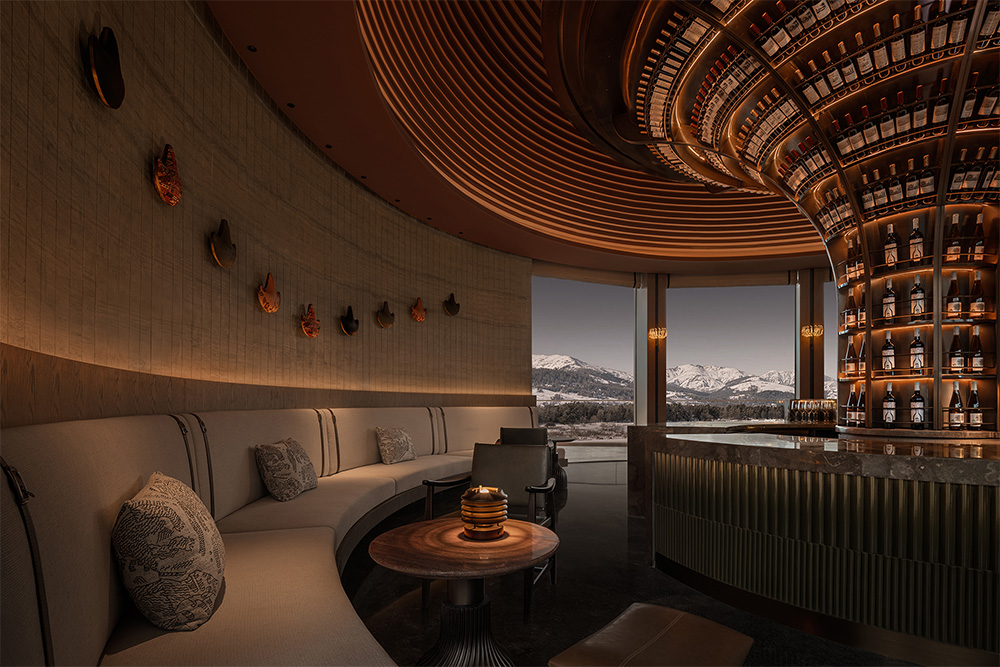
At the restaurant’s core, a sculptural circular bar evokes a solitary tree on the steppe, shaping the spatial layout
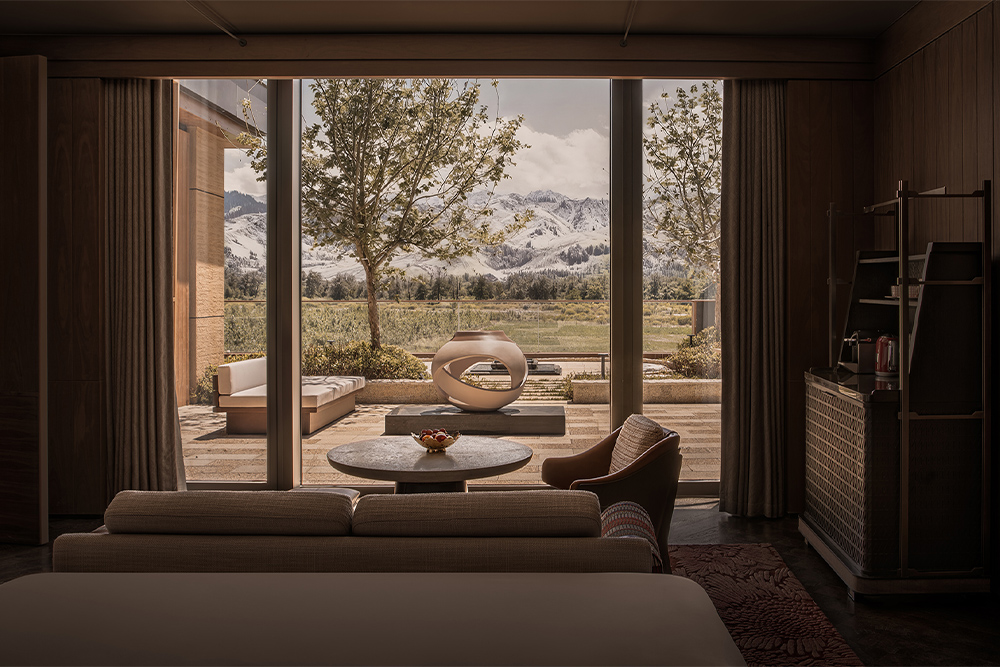
Guestrooms unfold beyond carved double wooden doors, where a restrained palette frames sweeping landscape views
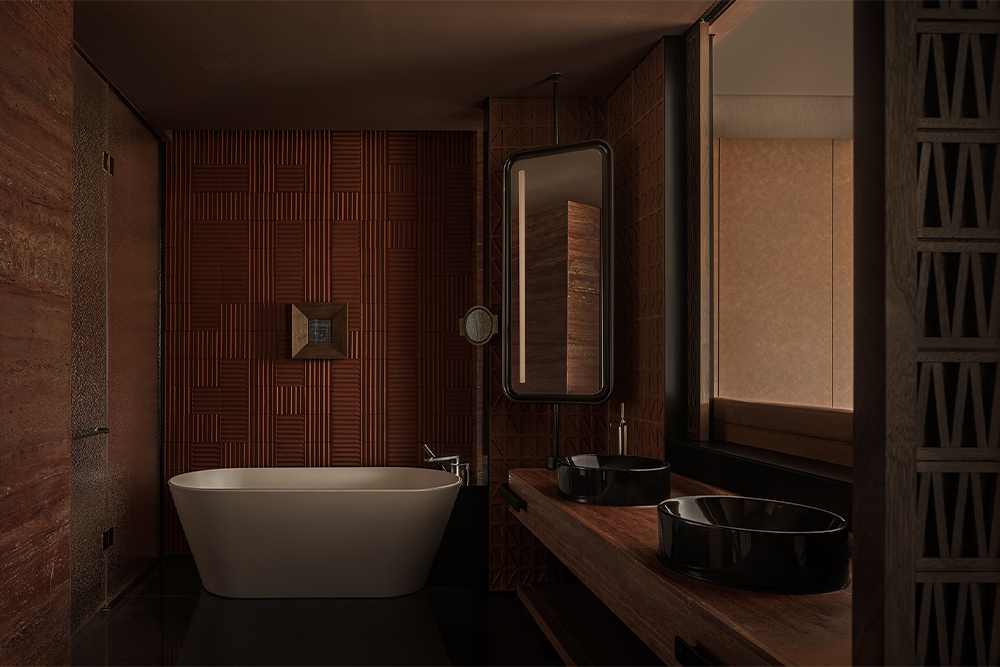
Dark wood finishes bring a moody sense of calm to the bathrooms, which are centered around a freestanding tub
This article originally appeared in HD’s April 2026 issue.