
It was stiff competition and an impressive array of work displayed at the 2010 Earth-Minded Awards (EMAs), presented by the American Society of Interior Designers (ASID) and Hospitality Design (HD) magazine. This year’s EMAs were judged by Tama Duffy Day, LEED AP, principal and national interior design healthcare practice leader, Perkins+Will; past EMA winner Peter Hapstak, design principal, CORE Architecture, and Ron Sheldon, vice president of development & construction, Kimpton Hotel & Restaurant Group.
Ultimately four winners were selected across three categories-hospitality design product, hospitality design project, and student hospitality design project. Winners were selected based on a criteria including efforts to create a product or space that is environmentally innovative and aesthetically pleasing; products that promote sustainability including energy savings, lighting, flooring, fabric, wall covering, seating, case goods, etc.; and source efficiency and recycling and waste management within the development and manufacturing process.
And the winners are:
Earth-Minded Award for Hospitality Projects
Winner: Aria Resort and Casino
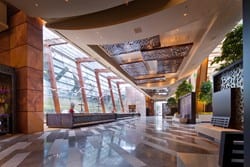
Currently the largest LEED Gold hotel in the world, Aria boasts pioneering green technology and careful design choices that greatly reduce the ecological impact of the project itself. Reclaimed barn wood is used on the hotel registration desk, locally sourced stone clads the Aria podium exterior, and green label carpet is used throughout the building. In addition to finishes, many of the raw construction materials were diverted, including the reuse of more than 260,000 tons of construction waste and over 80 percent of the imploded Boardwalk Hotel formerly on the site.
Among its sustainable distinctions, Aria possesses the first fleet of clean-fueled CNG stretch limousines and is the first resort on the Las Vegas strip to generate its own electricity at an onsite power plant. Part of the state-of-the-art campus central plant, the 8.2 megawatt natural gas fired combined heat and power plant (CHP) generates more than one-third of the total volume of electricity used at Aria. The CHP operates at an overall efficiency level that is nearly double that of conventional power plants through the capture and use of thermal (heat) energy generated in the power producing process (9 megawatts). Rather than emitting this heat into the atmosphere, the “waste” thermal energy is deployed year-round in the heating of the domestic water system, including hotel room fixtures and swimming pools.
Regarding water, perhaps no natural resource is more precious in the local desert climate. From advanced plumbing design to continued investment in low-flow technologies, developing conscientious operating practices on an ongoing basis is a priority at Aria. The hotel has been designed with low-flow fixtures in the guest rooms, restaurants, and public spaces. Native and drought-tolerant plant species were utilized in landscaping for their heat and low-water tolerance, using 60 percent less water. During construction reclaimed Monte Carlo cooling tower water was used for dust control (2.4M gallons saved).
Initially, there was not a capable construction waste recycling company in Las Vegas. Aria chose to give a loan to a small, local recycling company to purchase equipment and a fleet of trucks and develop capacity. During construction, Aria and its partner recycled 285,926 tons of concrete, steel, glass, metals, and wood and achieved 93.5 percent recycling rate. Aria’s goal is to recycle a minimum of 60 percent of its total waste in its first year of operation compared to an overall Las Vegas commercial recycling rate of 15 percent.
Each guestroom is equipped with the Control4 Suite System, a platform that enables all guests to customize all of the various amenities to their unique preferences. When guests open their hotel room door they are greeted with an automated welcome experience: the lights gradually come on, the drapes open to spectacular views of the city or mountains, and the TV will turn on to display a list of automated controls. Each of these levels can be set at the touch of a button and are remembered for future stays. Further, upon exit all systems revert to an unoccupied setting to conserve energy.
Winner: Alila Villas Uluwatu
Developed completely with materials sourced from Bali and surrounding islands, Alila Villas Uluwatu, designed by Singapore-based WOHA Design, is registered for Green Globe certification and will be the first hotel in Bali to get the highest level of certification for Environmentally Sustainable Design (ESD). The resort encompasses many ESD measures into its design including using local materials, water conservation with rain gardens and grey water systems that will recycle shower and bath water and landscaping that has been designed to maximize use of local plants.
Located on the dry savannah landscape of the Bukit Peninsular on the Indonesian island of Bali, the architecture of the 50-suite hotel and 35 residential villas is inspired by the local farmers’ terraces. A terraced roof was developed using Balinese volcanic pumice rock, which is a natural insulating material. These low terraced roofs keep open the site’s unique wide panoramas. The hillside villas are designed as pavilions linked by bridges across water gardens, tucked into the hillside as terraces.
Materials are all sourced locally-the walls use stones from the actual site from the road cuttings, while all other materials are either from Bali or Java. Only recycled Ulin timber and bamboo was used. Craftsmen in Java and Bali made the furniture, lamps and accessories.
Beyond the design, Alila is located in an impoverished, rural area. The resort has replaced marginal agriculture with tourism that generates substantial employment and income for local people. Through showcasing local skills, materials and vernacular elements, it confirms the local people’s opinion that they live in a marvelous place that should be cherished and maintained.
Earth-Minded Award for Hospitality Products
Winner: Glass Series Guest Interface Device Suite by INNCOM
Glass Series Guest Interface Device Suite by INNCOM is an eco-friendly lighting and thermostat central control system. Made from recyclable glass and plastics, all models are capable of simultaneously controlling lighting, fans, drapes, privacy notifications and thermostat settings. A standout feature, the “green button,” allows guests to opt into the hotel’s conservation program with the touch of a button. From a design standpoint, the glass touch surface offers a blank canvas for the designer wishing to customize a look with colors, fonts, images and functionality.
Earth-Minded Award for Tomorrow
Winner: AIS Senior Studio by Michelle Kiese, Student Member ASID
An interior design student at the Art Institute of Seattle and ASID student member, Kiese designed the building to function like a living structure, using a flower as inspiration. Like a flower, the building opens and closes at different times of the day to conserve energy. The building uses solar panels to sustain both heat and electrical needs and shuts down resources when they are not in use. Additionally, the building captures rainwater throughout the year, saving more than 41,000 gallons per year to be reused around the resort.