

Architectural firm Jova/Daniels/Busby has completed work on the $55 million green expansion of the Atlanta Botanical Garden. The project’s masterplan called for complete reorientation of the garden, including the addition of a sustainable parking deck and new visitor center as a launch pad for a number of new amenities within the garden. J.W. Robinson & Associates served as associate architect, while EDAW/AECOM offered landscape architecture services.
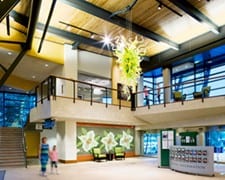
Strategically designed to integrate with the natural surroundings, the visitor center combines stone, steel, and glass, creating a pavilion that serves as the gateway to the gardens beyond. The building, which provides 30 percent energy savings over standard guidelines, is nestled into a hillside to aid in natural heating and cooling insulation. The open-aired central lobby pavilion takes full advantage of natural cross ventilation; HVAC units are programmed for auto shut-off when doors remain open.
The center’s green roof provides a natural green barrier to reduce heat gain and energy usage. Covering nearly 35 percent of the roof area, the green roof utilizes plant coverings, offering a new wildlife area and an additional garden for visitors.

Meanwhile, the new seven-level, 750-car parking facility is nestled into a steeply sloped hillside sheltered and camouflaged by a heavily landscaped berm of native foliage, flowering vines, suspended planter boxes, and cable grid over which the living roof grows. Designed to achieve LEED Gold certification, the parking deck is fully integrated with the terrain to reduce the impact on the environment.
To recoup green space for the garden, the parking facility covers 1.1 acres of land and returns 3.6 acres of existing paved area to its natural state. The parking deck is constructed of reinforced post-tensioned concrete. Natural ventilation, via an open airway, eliminates the need for mechanical ventilation. The garden has also designated 5 percent of its total parking space to alternate fueled vehicles and an additional 5 percent of the spaces to promote employee carpooling.
A 95,000-gallon capacity precast concrete cistern captures storm water runoff from approximately six acres to aid in water conservation. The cistern harvests storm water from a seven-acre watershed, providing irrigation for 40 percent of the property. In addition, the rate of storm water runoff from the property was reduced by 30 percent. To further enhance water conservation efforts, low-flow plumbing fixtures are used throughout the development. Additional green initiatives include:
• A minimum of 20 percent of the building materials and products used during construction were manufactured within a 500-mile radius.
• Recycling and/or salvaging at least 75 percent (by weight) of construction, demolition, and land clearing waste.
• Restored at least 50 percent of the site by replacing impervious surfaces with native or adapted vegetation.
• Removed trees were shredded on site and used for ground cover, erosion control, root protection, and mulch.
• Regionally available hardwoods were used on all casework and stairs.
• Implemented EPA erosion and sediment control measures during construction.
• Purchase of certified green-e power from local Power’s Green Energy Program to operate the visitor center and parking facility. Power is generated by clean energy sources such as sun, wind, water, and biomass energy production.
• An on-site recycling area dedicated to the separation, collection, and storage of materials for recycling, including paper, corrugated cardboard, glass, plastic, and metals.
Photo credit:
Jova/Daniels/Busby Architects, Planners and Interior Designers
Photography @ 2009 Kieran Reynolds