
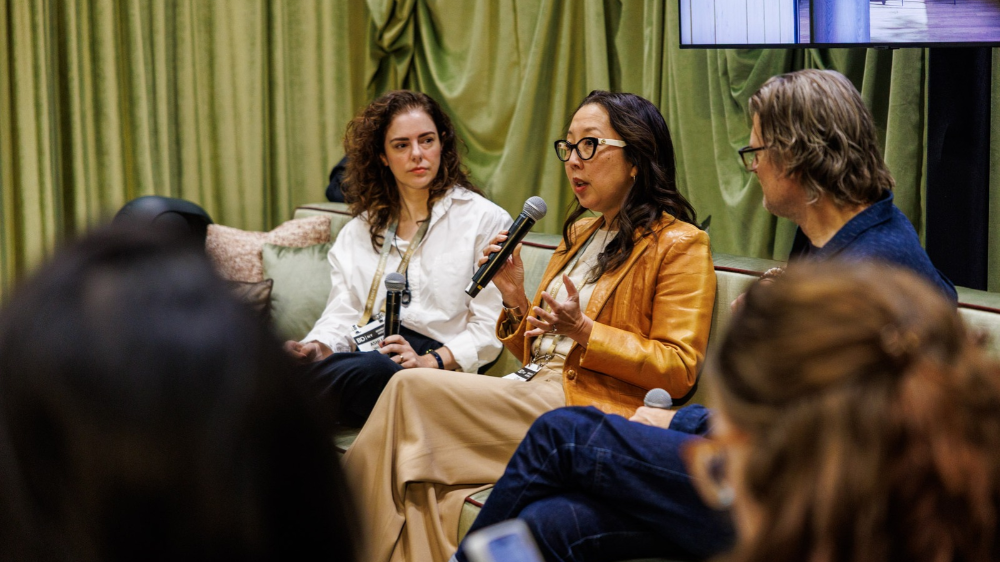
Day two of BDNY explored how hospitality spaces can deepen connections with guests and the communities they serve. Across five sessions, speakers discussed the changing expectations reshaping restaurants, the civic potential of food and beverage spaces, and the balance between preservation and profitability. They also examined how emotional design can translate into lasting loyalty. A common thread emerged: Understanding what people value is essential to creating places that resonate—and businesses that endure.
1. Fine dining isn’t dead—it’s being redefined
During Is Fine Dining Dead? Rethinking the Modern Restaurant Experience, moderated by Daniel Scovill of Arcsine, panelists quickly settled the headline question. Fine dining is alive. It just looks different. White tablecloths, plush carpets, fixed-course menus, and hushed, ceremonial service are no longer prerequisites. Ashley Wilkins of Islyn Studio and Cori Tahara of MINA Group described a move away from the stuffy, intimidating “whisper joint” toward thoughtful food and attentive hospitality. “It’s still special. It’s still guest-focused,” said Tahara. “But it’s not scary.”
That shift puts the emphasis on the full guest journey, from arrival to the return visit, and on operational details that free staff to focus on hospitality rather than work around the design. It also requires a clear point of view. “When you design for everyone, you design for no one,” Wilkins said.
2. Adaptive reuse can deliver profitable, soulful projects
When considering putting a 100-guest hotel in a converted warehouse, how do you honor the building’s past while making it profitable today? That was the challenge a multidisciplinary panel tackled during The Renovation Equation: When Preservation and Profitability Align, a session that walked attendees through the process of evaluating adaptive reuse opportunities and balancing preservation, performance, and profitability.

Using the fictional hotel as a case study, the panelists shared how brands can successfully adapt existing structures. “We look at all these layers, from location to building architecture that can be preserved,” said Ashley Ewing Parrott of the Saturday Crowd. “All historic properties have a story to tell. We aim to personify the building. What has it seen? What has it survived?”
Guests crave nostalgia, and projects should recognize that from the start, said Whitney Krieger of Rockbridge Hospitality. “How can we create a sense of soul in a building?” Krieger asked. Mary Gilmore of Campo Architecture & Interior Design agreed, adding that character-defining elements deserve priority placement. “The historic pieces lend to guest experience,” she said.
Historic preservation projects cost more upfront, but the panelists noted that properties embracing and revitalizing existing buildings and local culture gain a real marketing advantage. That advantage can “drive up daily rate, which can justify what we do,” said Melissa Shelton of Dear Valentine.
Still, the speakers cautioned developers to consult with experts across disciplines before committing to a project, to confirm its feasibility. “As we fall in love with these buildings, if the numbers don’t work, you’re setting yourself up,” Gilmore said.
3. F&B can energize an entire hotel
Guest habits are changing, and The Future of F&B: Design, Brand, and Cultural Relevance in Hospitality showed how operators are responding. Moderated by Beth Bloom of Beth Bloom Designs, the panel agreed that restaurants are in “the business of experiences.” Guests still want celebration and social connection, even when they eat or drink less. Will Nazar of Major Food Group noted that liquor sales are down, but guests are choosing quality over quantity, spending more on wine while drinking less of it. Nazar and Quality Branded’s Michael Stillman also observed that guests taking GLP-1 medications still order several dishes for the full experience. They simply eat less of each one.
The business model is shifting alongside behavior. Nazar pointed to private members clubs, where dues replace the pressure to turn tables across early and late seatings, so the focus can stay on the meal and the community. Design is adapting as well. Flexible elements such as curtains let operators close off sections during slower seasons without making the room feel empty. As the economics evolve, the most resilient restaurants will be the ones designed to flex.
4. Using emotion to exceed guests’ expectations
Return on investment isn’t the only business asset project teams are measuring today—instead return on emotion (ROE) is becoming an important framework in hospitality with real revenue implications. “The ROI is very much tied to ROE,” said moderator Meena Krenek from IA during The ROE of the Room: How Emotional Design Becomes a Business Asset in Boutique Hospitality.
Panelists discussed four sensory levers that shape guest experience: light, texture, arrangement, and objects/artifacts, and how intentional deployment of each translates into loyalty, dwell time, social amplification, and rate premiums. “Layout is the bones to create an amazing space,” said Rockwell Group’s Alex Gong.
When considering these elements, the speakers said it’s important to consider what emotional outcomes a project wants guest to feel and then how to design for it. “We want to create that moment where you transform,” said Journey/ICRAVE’s David Taglione. “It needs to be transformational to leave a lasting impression.” Michael Wood from Wynn Design & Development added that it’s not only important to create a sense of wonder but anticipation for guests. “I love the idea of anticipation because that’s what we all want when we go on a trip,” he said. “I want to exceed what the guest is fantasizing about.”
5. Hospitality can be a form of civic design
The day closed on a different kind of destination. In Designing Hospitality at the Obama Presidential Center: Creating a Destination Through the Guest Experience, the center’s director of design, Kimshasa Baldwin of Deture Culsign, Architecture+Interiors, and Studio GOGA’s Gordana Jordanovska shared how F&B helped make the Chicago institution a destination for its South Side neighbors, not just visitors from around the world. “I needed to make sure that it was a destination for the people that live there,” Baldwin said.
Brought on with construction underway, the team replaced a fast-food-style layout with a fully open kitchen, inspired by Michelle Obama’s writing about the kitchen table as a place of family and community. The restaurant, which is open to the public without a museum ticket, was designed to flex from everyday dining to events and community programming. “This is not something that’s going to get refreshed in five years,” Jordanovska said, but something that will “impact generations to come.”