
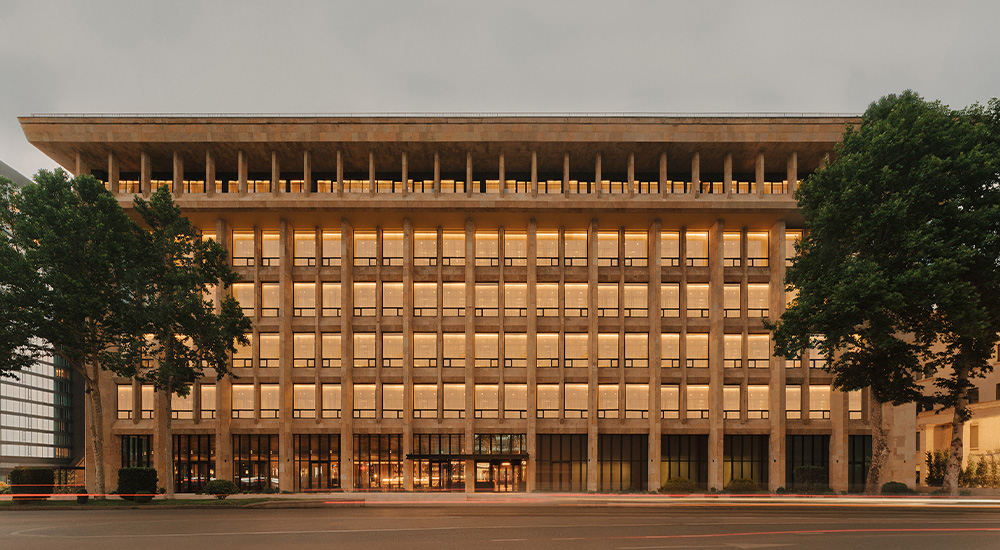
There are scars of history left untouched at the Telegraph Hotel, a 1970s Brutalist structure that was originally built as a central post office and telegraph center by architects Lado Alexi-Meskhishvili and Teimuraz Mikashavidze. Awarded the National State Award in 1983, the building rests within Tbilisi’s sloping landscape, its monolithic presence both grounding and quietly watchful.
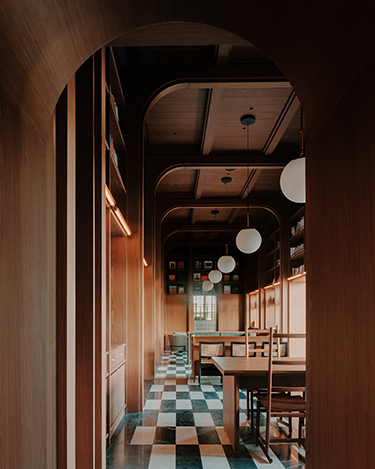
Checkerboard floors transition into warm wood finishes at the Grill, one of the hotel’s nine dining venues
After decades of abandonment, Shanghai-based Neri&Hu Design and Research Office was tapped by Silk Road Group founder George Ramishvili to transform the landmark into a hotel without erasing its history. The building’s Brutalist bones and legacy as a community gathering space now inform the 239 guestrooms and public areas, which unfold around nine F&B concepts—from Tatuza Jazz Club to the vintage-meets-modern Grill and chic day-to-night café Bell & Gray—that all flow into a central courtyard.
“The moment of greatest surprise came when we first saw the inner courtyard,” shares Lyndon Neri, cofounder of Neri&Hu. “While we had studied the plans, the powerful spatial experience of that void—its scale, its light, and its potential as a new urban heart for the hotel—was something that could only be felt in person. It was a profound reminder that architecture is ultimately an experiential art, and that the genius of an existing building can reveal itself in unexpected ways during the process of transformation.”
The building’s Soviet past is most palpable in this space—as it is in the concrete façade—so the design team leaned into it, carving a series of corridors that recall Tbilisi’s narrow alleyways and open onto the courtyard, reinterpreting it as an urban square. Looking skyward, communal balconies on each floor mirror those found in traditional Georgian residential complexes, “fostering what Richard Sennett calls ‘urban porosity,’ deliberately blurring the boundaries between public and private to encourage spontaneous social engagement,” says Neri. Here, the angular architecture and raw materials are lightened by lush greenery that cascades down from each balcony, lending a subtle sense of movement.

Inside, original exposed concrete columns and beams line the corridors and public spaces. “We believe a meaningful urban future cannot be built by erasing the past, but rather by engaging with it directly,” says cofounder Rossana Hu. “The building’s ‘cracks of time’ in its fragments, voids, and scars form a living palimpsest of collective memory and contested history. Exposing them was an act of surgical precision and poetic grace.”
New architectural insertions are detached from the existing curtain wall, which “respects the original structure’s integrity while introducing a new layer of experience,” Hu says. “This ‘gap’ creates a threshold between past and present, allowing guests to move through and between histories, rather than simply occupying a renovated shell.” These interventions, while sleek and modern, sit in dialogue with the original elements, introduced through travertine slabs, walnut woods, handmade ceramic tiles, and powdercoated metal sheets.
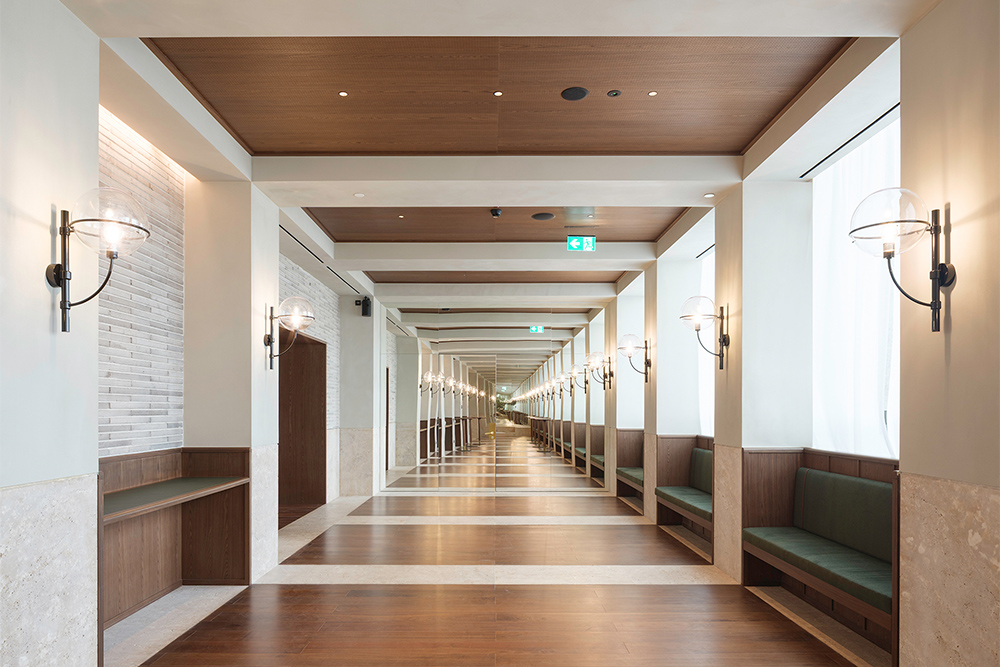
A network of corridors, conceived as an extension of Tbilisi’s street life, echoes the city’s narrow alleys, guiding guests through public spaces that converge at the courtyard
Punctuations of color appear throughout, from sage banquettes in the reception lounge to tiles of the same hue in Italian restaurant Philosophico, offering moments of softness. Warmth gathers more intimately in spaces like the Wine Library, where dark walnut arches frame cozy seating arrangements and books are tucked into built-in shelving, inviting guests to pause and linger.
In the guestrooms, materiality and color shift toward a more modern expression. The railway carriage layout, for instance, is demarcated by fluted glass sheets framed in matte black stainless steel dividers. This dark framework is balanced by light woods and creamy curtains that filter daylight, giving the rooms an airy, diffused glow. The visual experience is subtly tied together with the green tones carried in from the public areas, appearing in the rooms via upholstered seating and headboards.
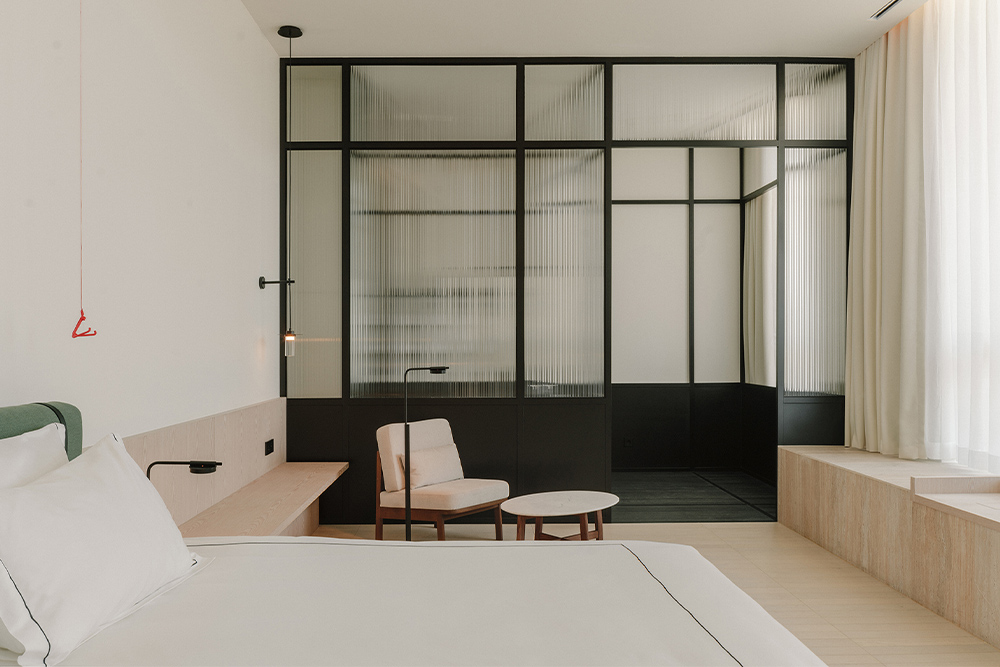
Railway-style guestrooms adopt a modern edge, divided by matte black metal screens and fluted glass, while light wood finishes evoke an airy, understated feel
The accommodation lineup culminates with the presidential suite, which unfolds as a more expansive interpretation of the same design language. Spanning 2,790 square feet, it comprises a living room, two bedrooms, and a generous private terrace with a seating area and plunge pool overlooking the city, extending the experience outward and allowing Tbilisi itself to become part of the stay.
Despite its modern revival, the Telegraph Hotel remains alive with the echoes of its past. “We hope [guests] will not simply visit a historical site but inhabit a part of history and its continuing story,” says Neri. “For a moment, they become temporary participants in the civic life of Tbilisi, connected not just to the city of today but also to the currents of memory and communication that have flowed through this site for decades.”
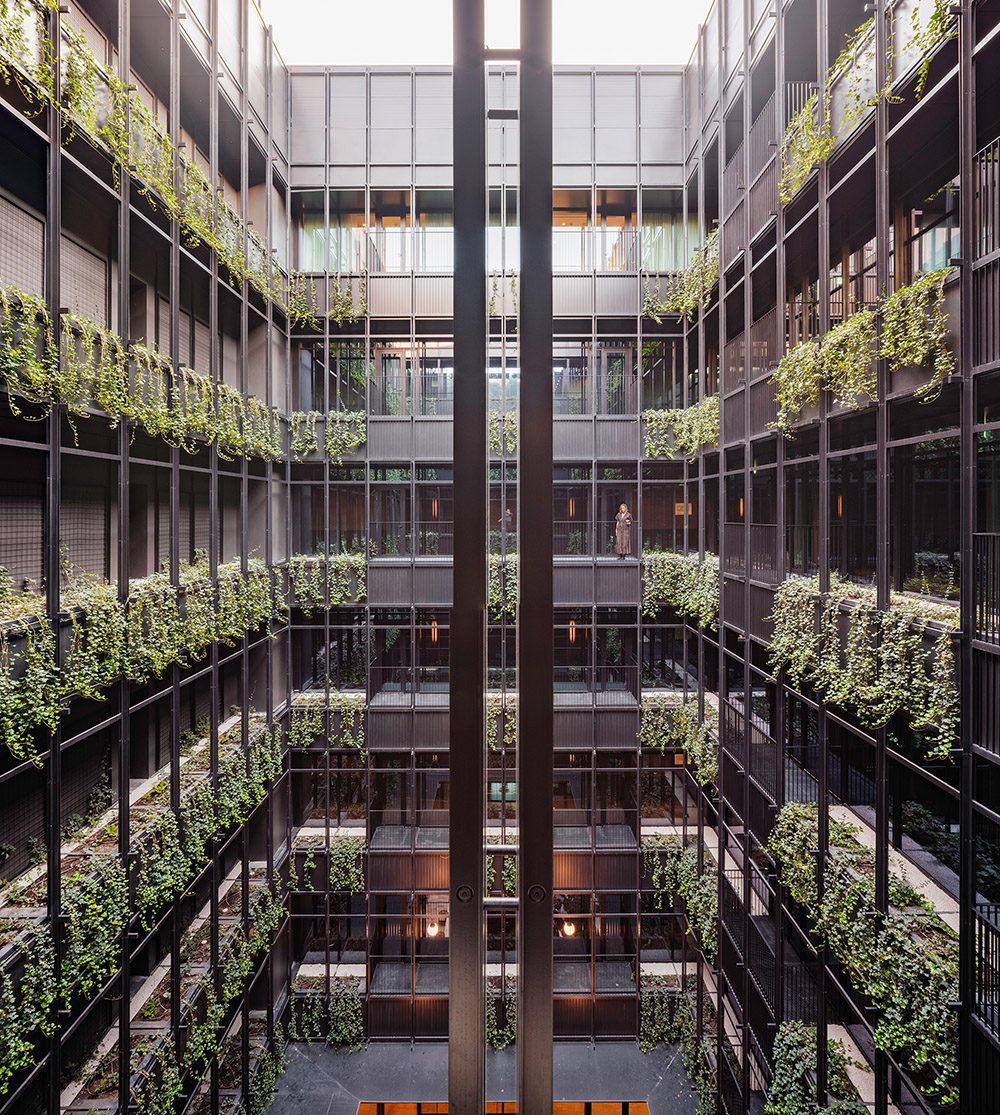
Guestrooms are arranged within the building’s original structural grid, rising around a central courtyard edged by black metal balconies and cascading greenery
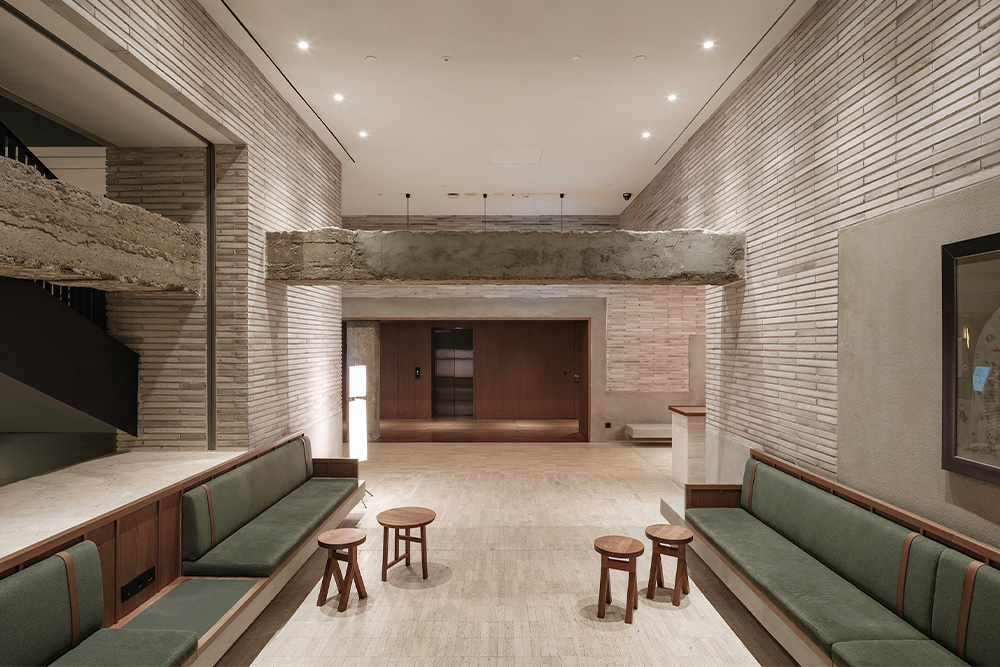
An original exposed concrete beam spans the reception lounge, softened by muted green banquettes and wooden stools
This article originally appeared in HD’s April 2026 issue.