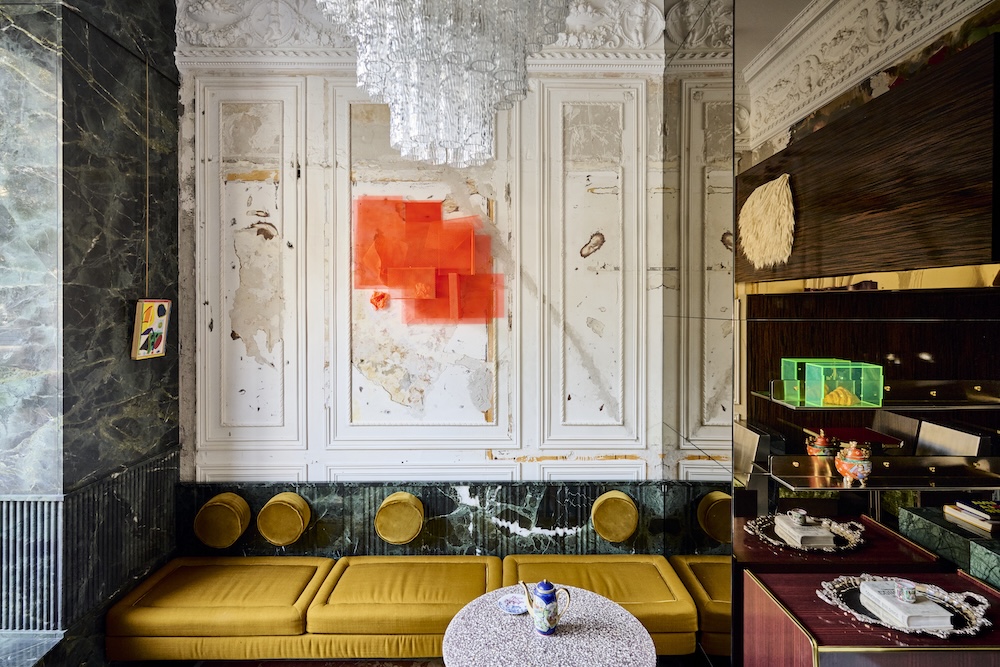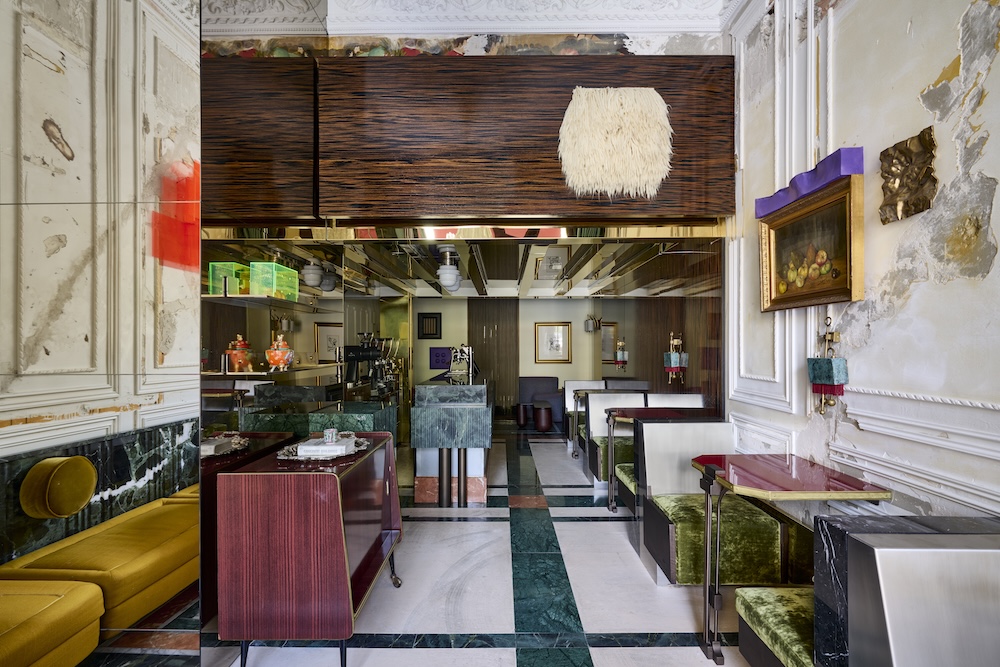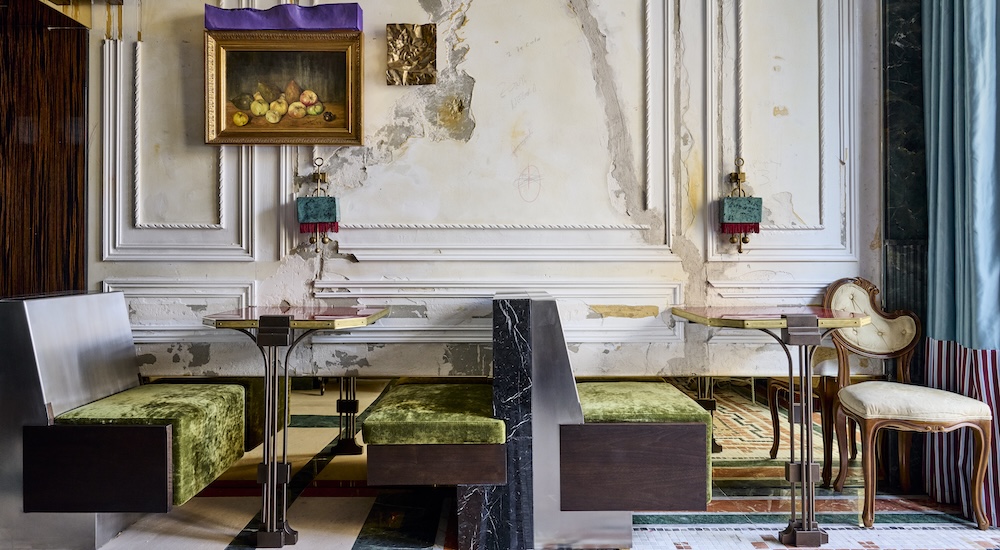
Located opposite the Buen Pastor cathedral in the coastal Spanish city of San Sebastián, Xauen Café reimagines a historic local namesake. Designed by Iñigo Iriarte, the 430-square-foot space is organized as a sequence of distinct zones that unfold through material shifts and changes in scale.
 Arriving at Xauen Café
The entrance, or anteroom, is treated as a compact, immersive volume. Its marble mosaic floor—comprising varied colors and stone types—recalls traditional residential entryways in San Sebastián. A mirrored baseboard runs along the perimeter, extending sightlines and amplifying depth within the tight footprint.
Custom joinery in burgundy-stained wood frames the storefront and door, referencing the city’s historic portals. Seating, meanwhile, is arranged to encourage interaction: an ochre velvet banquette anchors two central tables, while opposing benches evoke the face-to-face layout of a train carriage.
A Venini glass pendant introduces a point of contrast, drawing light and attention inward from the street, while a concealed dumbwaiter is integrated behind a full-height mirror.

Getting creative with low ceiling constraints
The Brew Bar addresses a significant spatial constraint, where the approximately 13-foot ceiling drops to 6.5 feet. The design minimizes visual weight by embedding the La Marzocco coffee machine below the counter, leaving only the taps visible.
Material articulation defines the bar’s presence: perforated metal, marble skirting, and a projecting fluted marble band subtly distort perception, making the counter appear lower than it is. High-gloss rosewood cladding wraps the walls and extends upward into a storage volume that occupies the reduced ceiling zone, consolidating visual mass while giving the area a distinct identity. Custom wall sconces, produced with a local ceramist, introduce brass and textile detailing as well.
A coffee lounge that introduces softer spatial rhythm
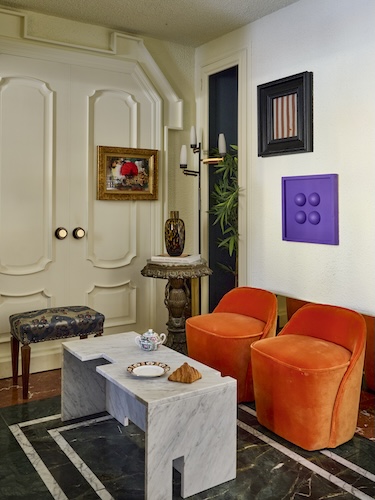
At the rear, the café transitions into the Slow Coffee area, where proportions and atmosphere shift. Stippled plaster walls add both texture and acoustic control, while low seating and tables encourage a more relaxed experience for lingering.
A framed double door at the back visually extends the space, and a brass column marks the transition to the stair leading to the kitchen. Compared to the density of the entrance and bar, this zone emphasizes softness and spatial release.