
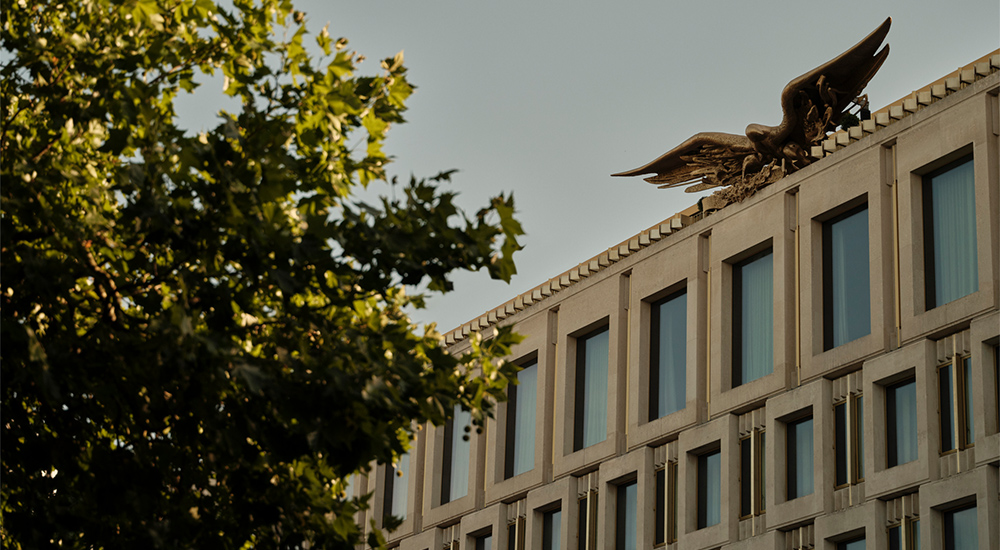
The 2017 relocation of London’s U.S. Embassy presented an extraordinary opportunity: the reinvention of a Grade II 1960 modernist landmark by Eero Saarinen, the Finnish-American architect behind St. Louis’ Gateway Arch and JFK Airport’s TWA terminal (now the TWA Hotel) in New York, into the Chancery Rosewood.
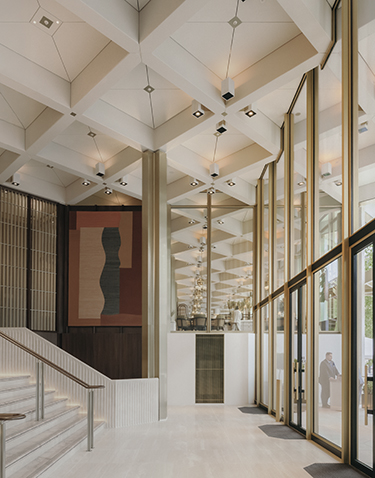
Saarinen’s load-bearing concrete diagrid ceiling was restored and extended to reduce the need for internal columns
Located on Mayfair’s leafy Grosvenor Square in a neighborhood long associated with North American diplomats, Saarinen’s “palace on the park” reopened last September as an all-suite 144-key destination. “You cannot get a better location in London,” says Trish Luyckx, chief design and project services officer at Rosewood Hotel Group, “especially with the tie-in to our brand’s origin in Turtle Creek, Texas. The result is a testament to the passion of everyone who’s worked on the project for over 10 years.”
From the outset, the design teams shared expertise to streamline operational flow, increase space, and establish eco-credentials fulfilling owner Qatari Diar’s desire to create lasting value for the destination and wider community. The powerhouse ensemble included ReardonSmith Architects and David Chipperfield Architects, alongside Yabu Pushelberg, AvroKO, Sagrada, and Joseph Dirand, Benjamin West, among others.
Nearly doubling in size with a new top floor plus two additional basement levels, meticulous heritage and planning consents were required given Saarinen’s unusual design. His “checkerboard” arrangement of spaces enabled a self-supporting exterior, while a 45-degree twisting of the conventional structural grid into a diagrid unified the entire building and reduced the need for internal columns.

“In a major feat of engineering and construction, the façade was lifted and suspended over a 98-foot-deep excavation for nearly three years while works below were completed,” says ReardonSmith Architects’ director Irek Pasek.
Restoring the historic property back to its original glory was not without its challenges, which included the listed diagrid ceiling that could not be used to supply air conditioning. The answer was a complex system normally used in museums that provided the best quality solution for heritage and sustainability.
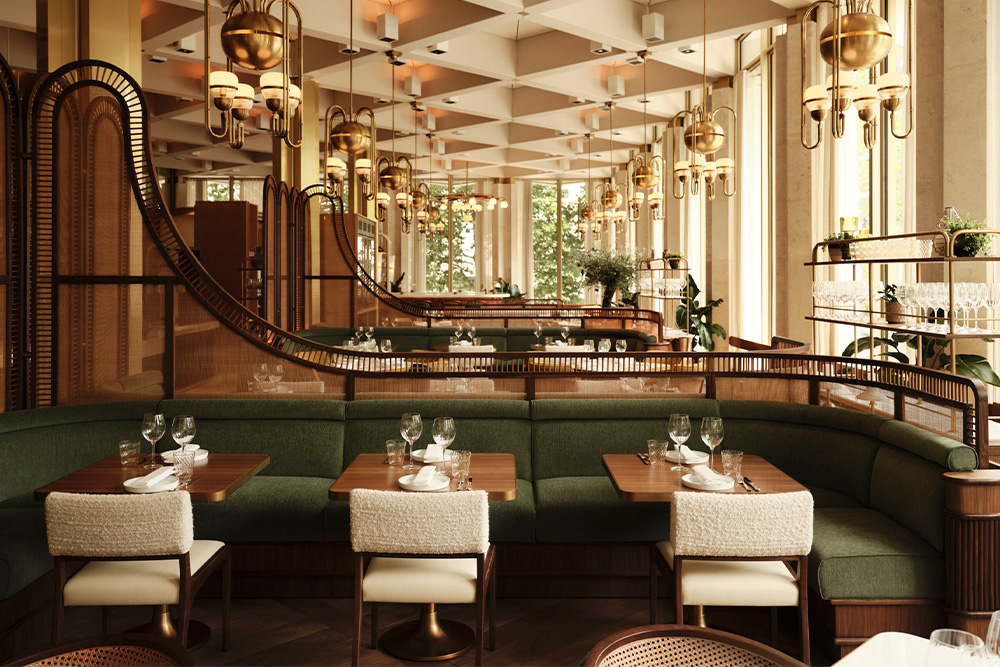
Serra’s seating plan plays off the exterior windows’ Cartesian geometry, reinforced by brass chandeliers
“Many BREEAM credits were achieved with seemingly invisible architectural provisions: enough basement space for a larger, more efficient plant; water-efficient vacuum drainage; biodiverse rooftop gardens; and waste and recycling monitoring during construction,” says Ryan Butterfield, associate director at David Chipperfield Architects. In addition, renewed and reconfigured elements—like brass window latches, balustrade trims, light boxes, and timber flooring—enhanced circularity and connection with the original aesthetics.
For the public areas, suites, and “houses” (named after American dignitaries such as John Adams and John F. Kennedy), Parisian architect Joseph Dirand opted for a James Bond-meets-“Mad Men” aesthetic. Furniture, some of which was designed by Saarinen, and classical lighting imbue 1960s-era poise.
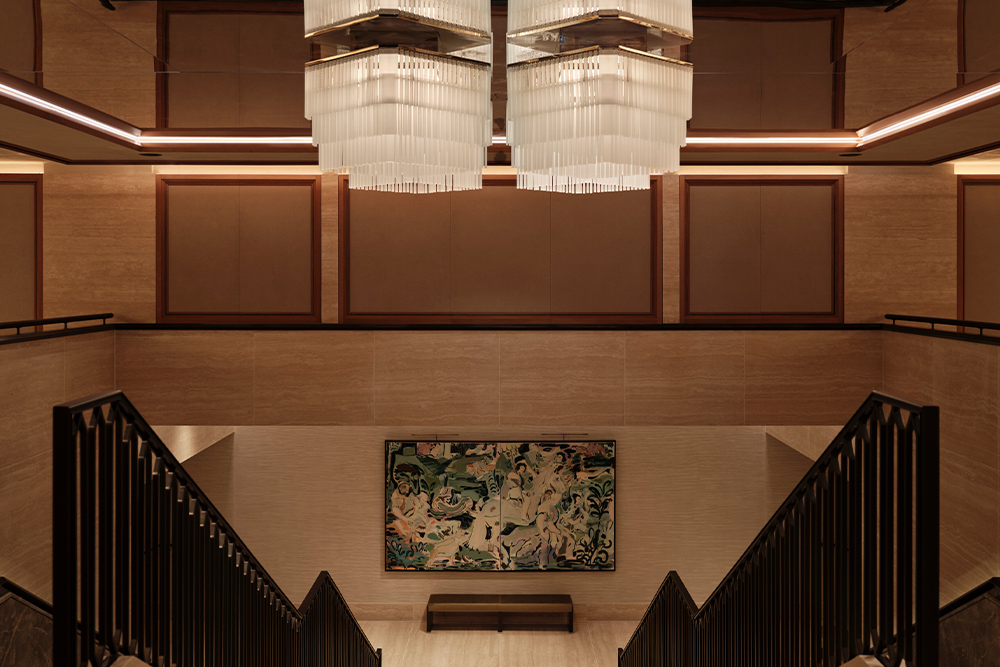
An in-house art concierge manages the hotel’s collection of 700-plus works, including pieces by David Hockney, Damien Hirst, Peter Blake, Tracey Emin, and Barbara Hepworth as well as emerging artists
In the central open passageways, meanwhile, illuminated shards inspired by swirling tree leaves in Grosvenor Square hang from a skylight, contrasting with rich walnut timber imported from Michigan.
Below, the reception lounge is the nexus from which F&B spaces radiate. Dirand’s graceful Jacqueline tea lounge unofficially honors beloved First Lady Jackie Kennedy Onassis. Paris-based Tristan Auer and Melbourne-based Bar Studio created preliminary concepts, with New York-based AvroKO fleshing out the designs and FF&E for Serra brasserie, GSQ deli, and Asian grill Tobi Masa. “To synergize with the façade windows’ rhythm and Cartesian geometry, we laid out Serra’s seating plan into bays reinforced by a relentless regularity of brass chandeliers,” says AvroKO cofounder and principal Adam Farmerie. “Second, we deliberately introduced curvilinear elements to juxtapose the building’s architectural language. Since Saarinen implemented curves in his other buildings and most of his furniture, we figured he’d approve.”
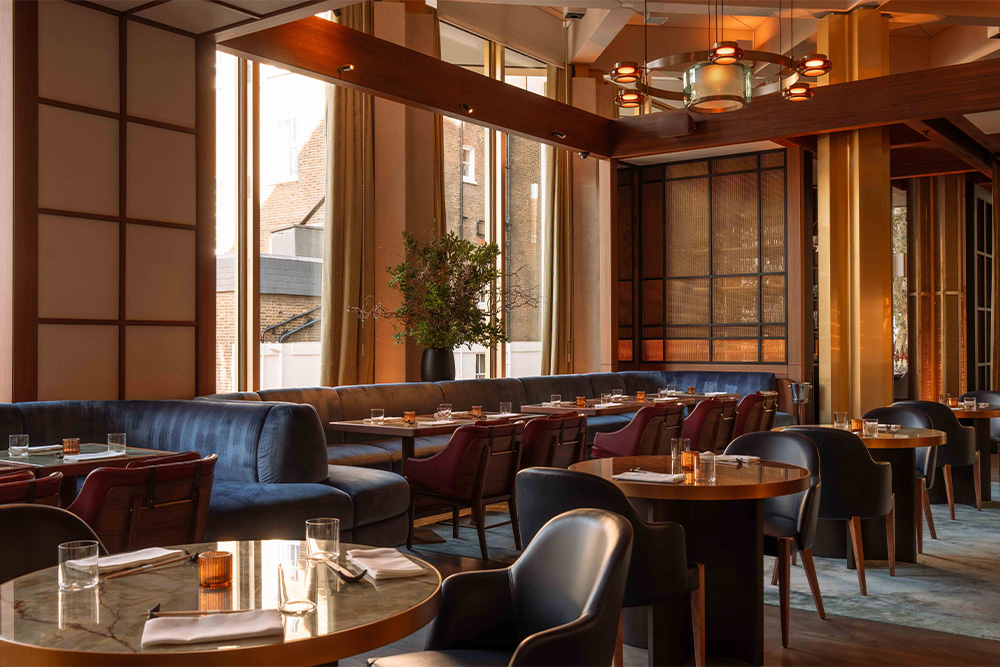
Tobi Masa restaurant juxtaposes the rigor of Saarinen’s architecture with refined materials informed by Asian craftsmanship
Sinuous lines in London-based designer Sagrada’s rooftop Eagle Bar reflect the fluid shape of the American Eagle sculpture originally crafted for the embassy by Polish-American artist Theodore Roszak from World War II B-52 bombers. Temporarily removed, then carefully restored and reinstated, it is a vital aspect of the building’s history.
Two levels below ground, Asaya Spa by Toronto- and New York-based Yabu Pushelberg embraces the absence of daylight through a sequence of residential-like rooms defined by proportion, indirect illumination, and atmospheric depth. Softness and calm balance the strength and structure of Saarinen’s architecture, transforming the subterranean setting into an intimate retreat. “Rather than bringing the building’s exterior language into the spa, we introduced a softer expression—one aligned with Rosewood’s vision of residential warmth and English sensibilities,” says partner George Yabu. Adds Glenn Pushelberg: “The spa respects the legacy of the structure while responding to its contemporary identity, creating a dialogue between authority and serenity, monumentality, and retreat.”
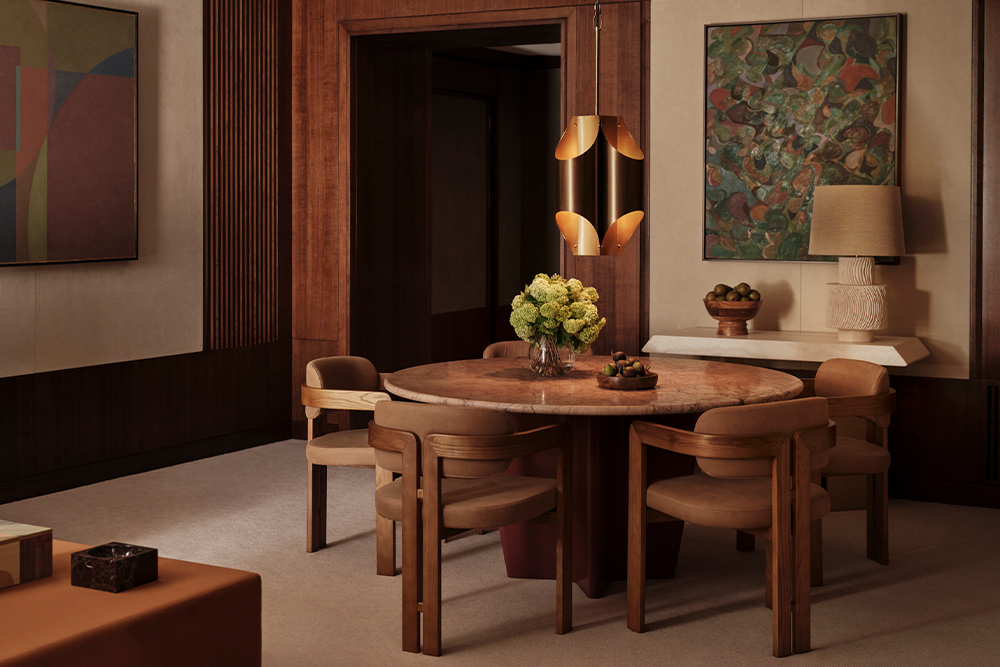
The suites’ 1960s-era aesthetics include furniture and lighting designed by Saarinen, Tobia Scarpa, Warren Platner, and Robert Sonneman
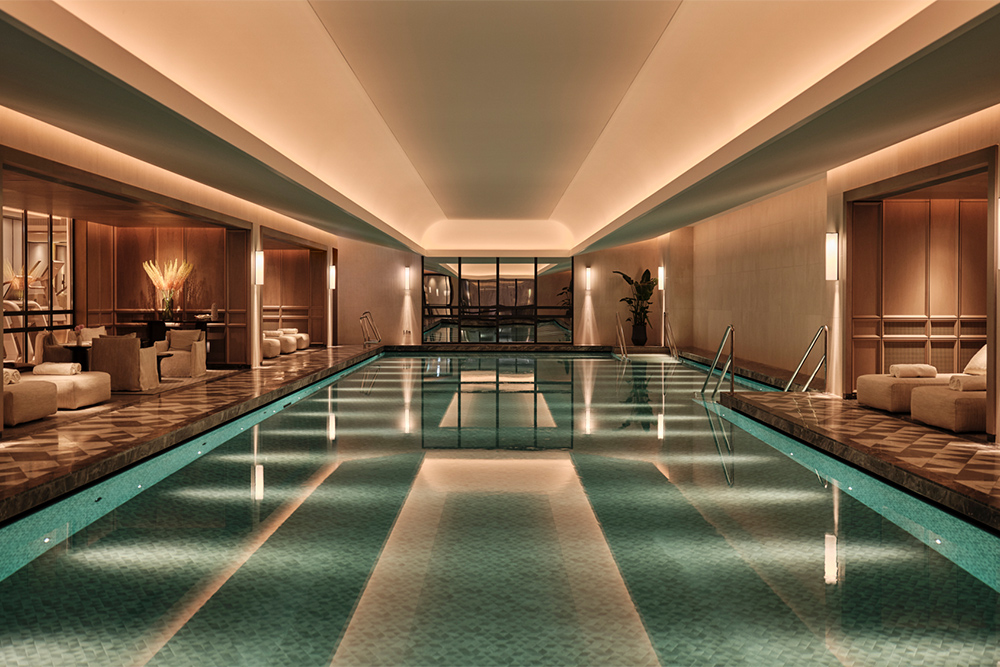
A sequence of cozy alcoves flank the pool, with mosaic stone floors, wood paneling, and artwork amplifying the residential feel
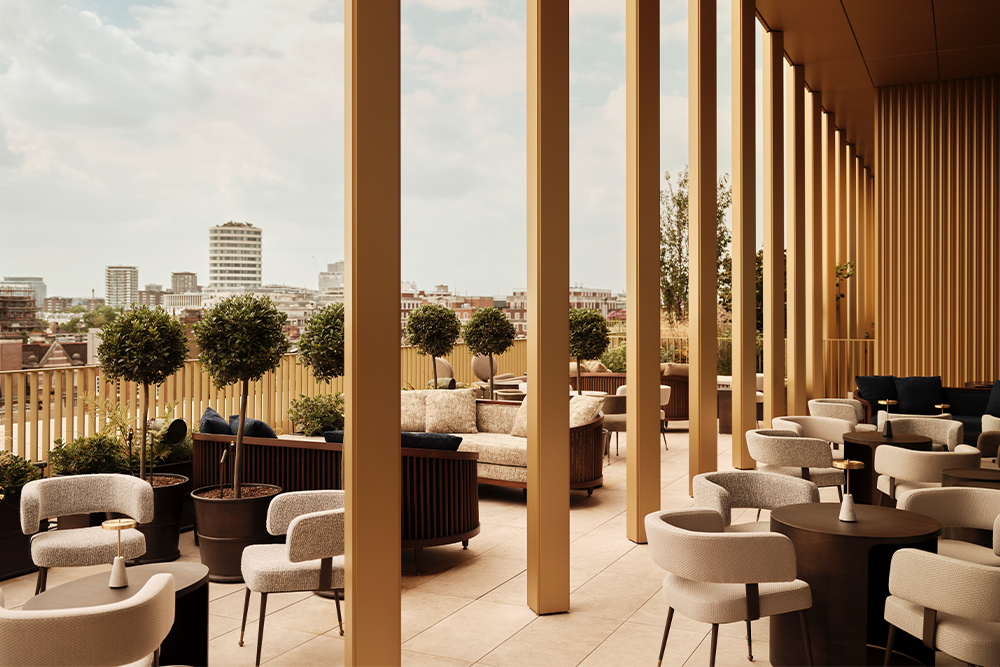
The rooftop Eagle Bar echoes the fluid form of the American Eagle sculpture—originally created for the embassy by Polish-American artist Theodore Roszak using salvaged World War II B-52 bomber parts
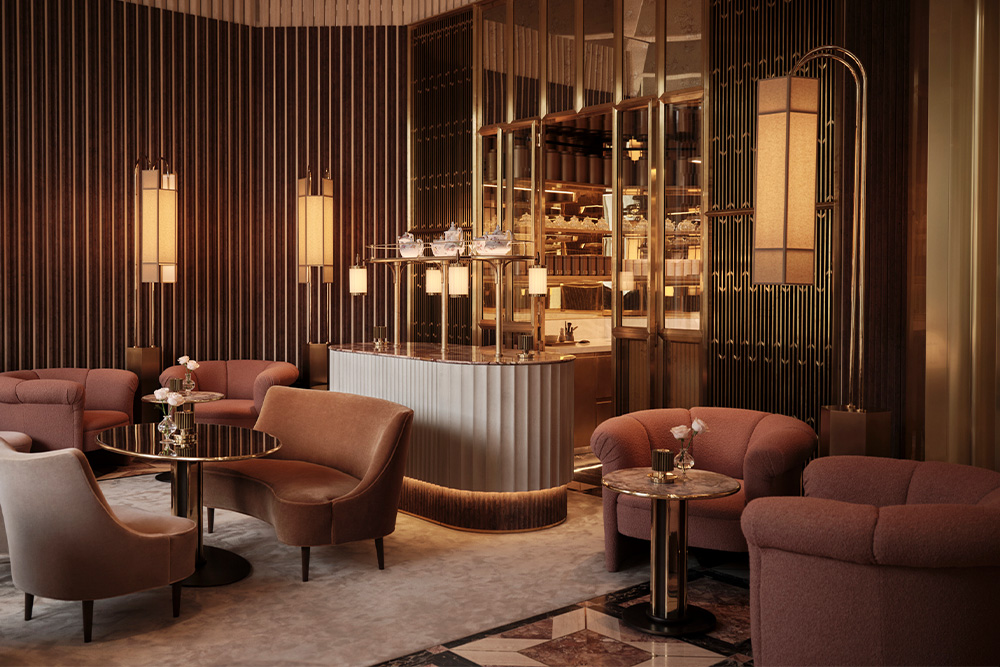
The graceful curves and rose hues of Jacqueline tearoom form an unofficial tribute to the beloved First Lady of the United States
This article originally appeared in HD’s April 2026 issue.