
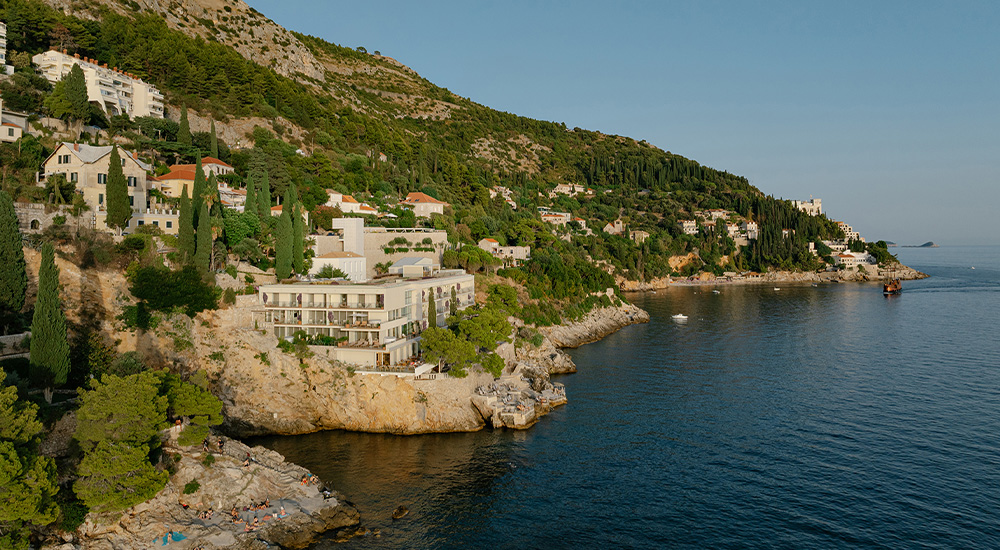
During the 1950s and ’60s, Dubrovnik—set along Croatia’s picturesque Dalmatian Coast—was a thriving hub of design and glamour, making it one of the most elite coastal cities of Eastern Europe. Its adjacency to Italy meant that it took design cues from as far back as the Renaissance, and as recent as Italy’s midcentury Golden Age.
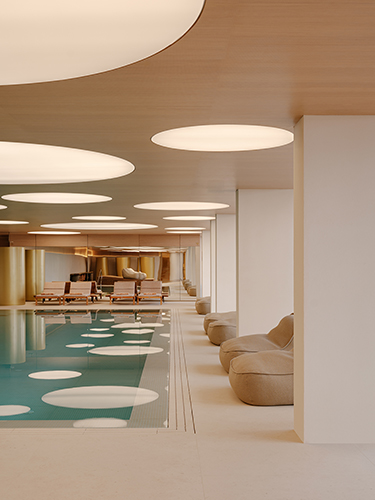
Surrounded by floor-to-ceiling windows, the indoor pool is flooded with natural light and offers access to a sundeck with panoramic views of the water
Consider the newly opened Villa Dubrovnik, which was originally built in 1961 by architect Mladen Frka as a residential building for political elites. Celebrating the various eras of its rich past, the refreshed look uses pieces by Italian designers, local artists and craftspeople, and a materiality that dates back to the city’s medieval roots—conceived through the lens of Brazilian architect Arthur Casas.
But, as Casas explains, the intercontinental approach was just what the seaside property needed. “Brazilian design carries a certain freedom in its relationship with landscape and materiality,” he says. “That sensibility allowed us to reinterpret Croatian identity with freshness rather than repetition. The result feels rooted locally, but with a distinct and cosmopolitan perspective.”
It all starts with materiality: Casas chose Croatian limestone paired with oak—one of the nation’s largest exports—to lay a foundation of pared-down, earthy luxury that blends in with the hotel’s cliffside environs. In an interesting reversal of typical flow, guests enter the hotel from Galanto, the only rooftop bar in Dubrovnik. They then proceed one level down to the reception, where neutral toned artwork from Dubravka Tullio sits alongside Gio Ponti-designed chairs and bespoke oak millwork that features a reinterpreted motif of Croatian lace, a tradition that has roots in the Renaissance.

One more level down, the hotel’s main public space level houses two restaurants—Michelin-starred Pjerin and indoor-outdoor Libero Bar—as well as an expansive library space. Here, nods to the culture appear through sculpture, artifacts, custom carpets, and mannequins dressed in the finest of local attire by designer Duška Nešić Dražić. “The goal was not to recreate the past, but to anchor the interiors in a cultural lineage that feels authentic and enduring,” Casas explains.
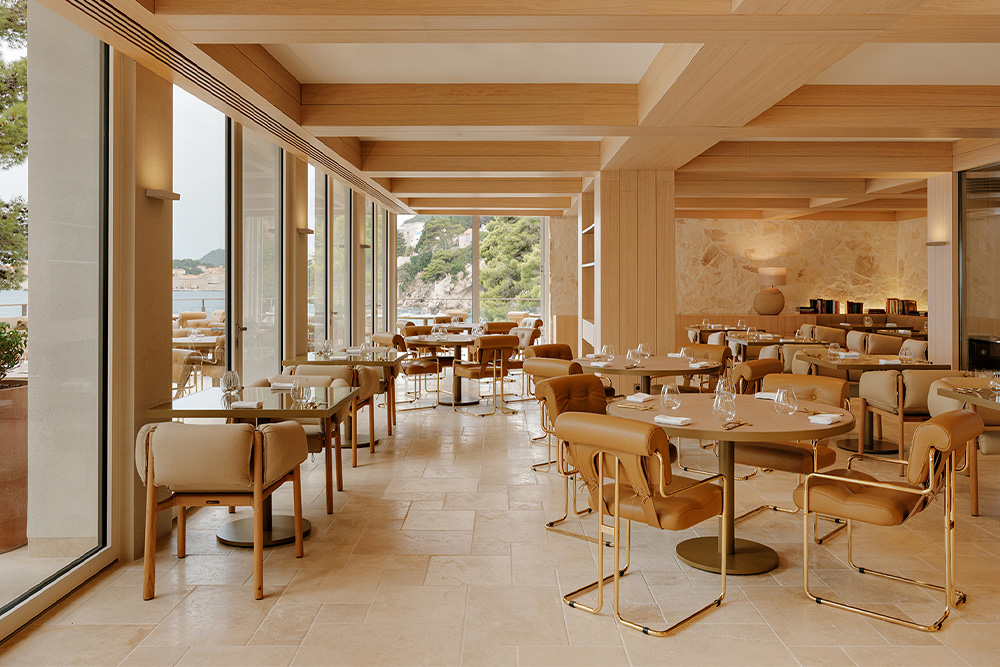
Pjerin restaurant exudes sophistication, thanks to bespoke millwork and nods to Italy’s midcentury Golden Age, inviting guests to feel cocooned within Old Town
Meanwhile, in the hotel’s 56 guestrooms and suites, midcentury and contemporary pieces inspired by Italian design combine with custom furnishings by Croatian furniture brand Prostoria. Every effort was made to imbue these spaces with local flair, from column capital sculptures inspired by those found in Old Town Dubrovnik by Zagreb-based Atelier Ekipa Kipara to bed throws featuring motifs from archival Croatian drawings and patterns. In guest bathrooms, the earthy color palette is interrupted only by vibrant Brazilian Via Appia quartzite that forms the monolithic vanities.
Casas admits that this labor of love was not without its challenges. “The site is accessed by a narrow, one-way road only [about 10 feet] wide, ending in a cul-de-sac. Many materials had to arrive by sea. Installing large elements required precise coordination, sometimes cranes, and constant adaptation to local construction limitations,” he recalls. “The entire process took nearly four years. Limitations forced precision, but that strengthened the project.” Despite these setbacks, he says, the result is a flawless assemblage of modern Italian sharpness, local art, and medieval materiality.
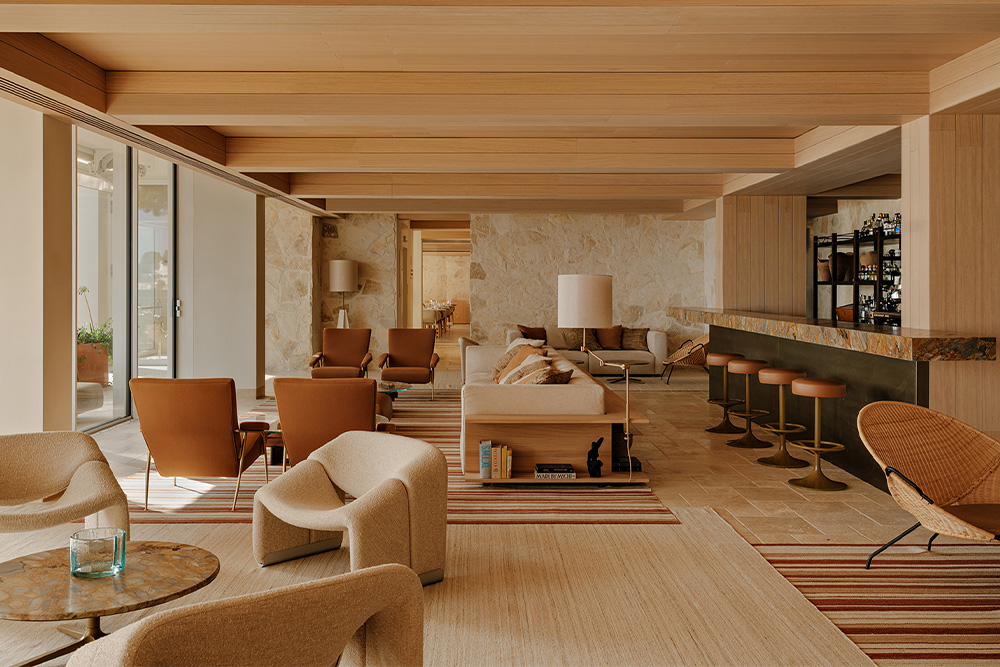
The indoor-outdoor Libero Bar is a relaxing retreat, perfect for afternoon tea or a brief respite
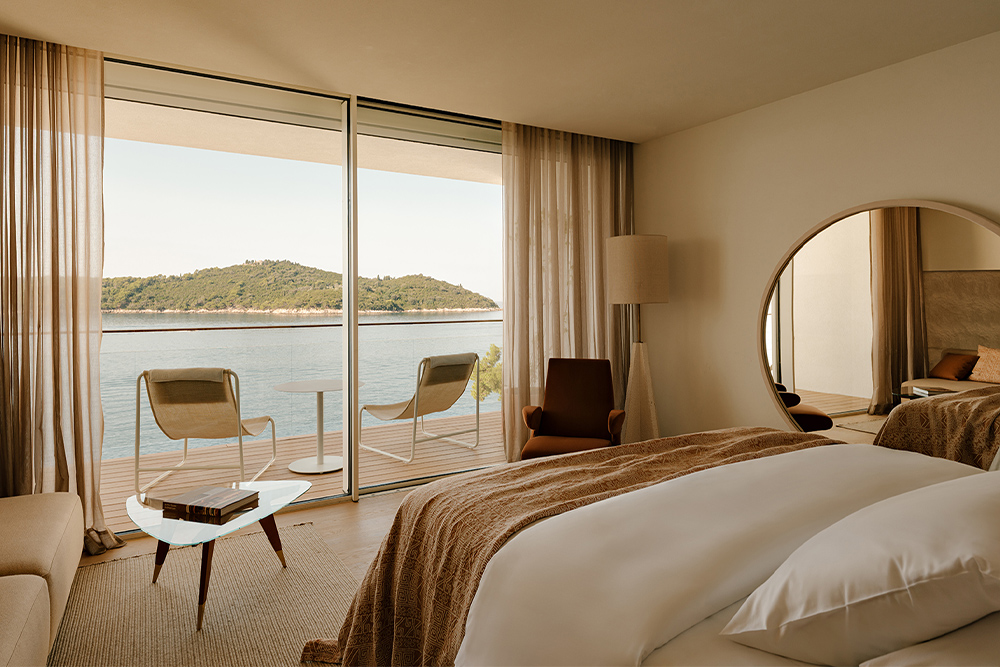
Guestrooms embrace Croatian design, with each accommodation boasting a serene palette of sandy white tones and notes of rich terracotta
This article originally appeared in HD’s April 2026 issue.