
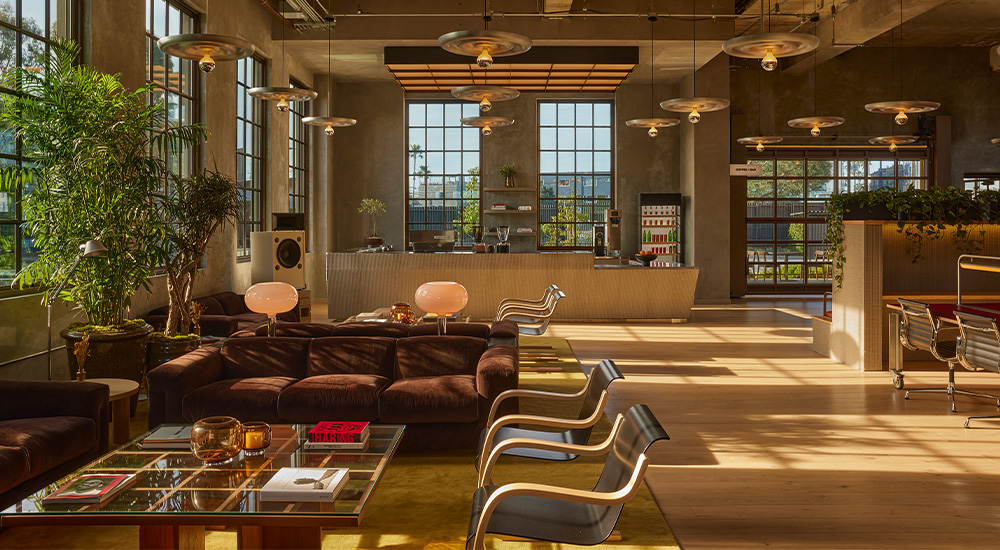
Across hospitality, retail, and mixed-use environments, these designers are approaching their work through the lenses of emotion, community, and connection. From adaptive reuse projects and experiential storefronts to boutique hotels and wellness concepts, their practices reflect an evolving vision for design—one that prioritizes engagement, authenticity, and lasting impact.
Nora Gharib, Gharib Studio
 Early in her career at transdisciplinary firm Snøhetta, Nora Gharib worked with the team on a post‑occupancy analysis of the nearly 25‑year‑old Bibliotheca Alexandrina in Egypt, an experience that revealed the lasting effect of cultural institutions.
Later, witnessing locals form a human chain to protect the library during a period of civil unrest deepened that understanding, reshaping her perspective on the built environment. “Understanding its impact on the people—even years after it was built—showed me how this library influenced literacy, education, community ownership,” she says. “Architecture is more than just a visual; it’s the social infrastructure for a lot of cities. It taught me how to design for people inside the spaces, not just for the ones looking from the outside.”

Gharib’s passion for human-centric design traces back to her high school years in Egypt, where she became fascinated by behavioral psychology and how physical environments influence the way people move and gather. This curiosity led her to begin her studies at Parsons before completing a bachelor’s of interior design at the New Jersey Institute of Technology, followed by a master’s in architecture from the University of Miami.

Little Words Austin is awash in rose pink, punctuated by arches and metallic accents
After Snøhetta, Gharib honed her technical and project management expertise at boutique firms. Around that time, she connected with Adriana Carrig, founder of customizable jewelry brand Little Words Project, and began collaborating on translating the digital brand into physical retail. Gharib’s concept centered on experiential elements like a bead bar, where customers can design their own bracelets. “People needed a space that was more of a hybrid,” Gharib notes. “How can we design for interaction rather than just transaction?” In 2023, Gharib was signed on to design all future Little Words stores, beginning with the Austin location. She launched her studio full time the following year.
Today, the studio’s team of six spans Miami, New York, and Egypt with a retail-forward portfolio that centers on human-focused design. “We have created such ease and convenience everywhere, the whole part that makes humans human is the friction in between,” she says. “That’s where the connection grows.”
Madelynn Ringo, Ringo Studio
 Madelynn Ringo recalls designing a wine label for her father’s vineyard in high school, a project that introduced her to the power of storytelling. Her mother was also an artist, so growing up in her Kentucky home, Ringo was always surrounded by color. “Creative expression was very much a part of our upbringing,” she says, “which allowed me to be curious and find different ways of making things.”
This creative freedom now defines her work at Ringo Studio. Most recently, she completed the Kuona optical boutique and clinic adjacent to the Beekman hotel in Lower Manhattan, where natural linen wallcoverings serve as a canvas for warm walnut millwork and chocolate flooring. “When people walk into that space, they have no idea that it’s an optometry clinic,” says Ringo.
Following her undergraduate studies at the University of Kentucky’s School of Architecture, Ringo moved to New York, holding various design-related jobs until she landed an internship at André Balazs Properties, working on special projects for Standard Hotels. “I mastered my hustle mentality,” she says of her early New York days. “I was super immersed. I had the energy to work until four in the morning every day—whatever it took.”

Warm peach tones blend with lilac in the nail salon at Chillhouse’s New York flagship
Ringo later earned her master’s of architecture at Yale and went on to become a senior retail designer at Glossier. There, she translated the brand’s identity into experiential pop-ups. “I was able to use architecture and interiors as a medium for [brand storytelling],” she says. “It opened my eyes to how much more it could be.”
She founded Ringo Studio in 2020, making her mark with a colorful concept store for fitness brand Bala and a serene Fifth Avenue flagship for wellness company Modern Age. Today, her four-person team continues to build momentum with its work on oral wellness boutique Sama, Lore Bathing Club, and the redesign of nail spa Chillhouse. On the board projects include fitness studio Soto Method; Entermezzo, a screen-free social sanctuary; and the first U.S. flagship for Canadian furniture brand Cozey.
“Our mission is to create spaces that inspire emotion,” Ringo points out. “Whether getting your nails done or going to an optometry checkup, you’re confronted with a space that makes you stop and notice. We call that the ‘heartbeat moment.’”
Carmen Cárdenas + Nicky Kyrtsis, Studio MaRō
 Before establishing New York-based interior design practice Studio MaRō, founders Carmen Cárdenas and Nicky Kyrtsis spent more than a decade in the entertainment industry, where they met and earned their stripes on the demanding sets of Broadway, film, and TV.
Kyrtsis began her career in costume design, from working as a Broadway associate designer for Toni-Leslie James to creating avant-garde pieces for high-profile clients like Beyoncé and Lady Gaga during her time at Izquierdo Studio. “I was baptized by fire,” Kyrtsis says. “Everything I made there had never been made before.”
Cárdenas, who immigrated to the U.S. from Peru at 7 years old, pursued film and art at Columbia University and then New York University before rising through the ranks of film production as an art director and production designer, leaving her touch on recent shows including “You,” “Inventing Anna,” and “Succession.”

A curved red velvet sofa anchors a lounge at the Luminaire at the Artisan
Despite their successes, the grueling hours of production schedules had them both longing for a more sustainable work-life balance, especially as they started families. In 2018, Kyrtsis began transitioning into interior design, balancing both roles until 2021. After securing a hospitality project in Philadelphia—the Artisan Hotel—she invited Cárdenas to collaborate in 2024. Together, the pair launched Studio MaRō a year later.
Located in an early-20th-century Philadelphia warehouse, the Artisan is an apartment-style hotel that features 16 units, each themed around traditional crafts such as the Cobbler, the Potter, and the Book Binder.Recalling their former lives, Cárdenas and Kyrtsis custom built some of the elements themselves, weaving leather and thread by hand to create the right light fixtures for each space. “The ethos in theater and film is just because it doesn’t exist in the world doesn’t mean we can’t make it,” says Cárdenas.
With the Diplomat, another project in Philadelphia, Studio MaRō is once again embracing the opportunity to shape guest experiences with artisanal craft at the forefront. “I’m excited for us, as working moms, to have taken control of our own destiny,” adds Kyrtsis, “and have the ability to build this into what we want it to be.”
Leah + Nathan Warkentin, Warkentin Associates
 Nathan Warkentin entered the creative arts by way of music. Design came later, as he realized these mediums served the same creative process. “[I love] putting it all together in a compelling way,” he says.
Growing up in Fresno, California, Warkentin studied studio arts at a liberal arts university before launching a wide-ranging career—from touring in a band to designing album covers, merchandise, and menswear. The throughline led him to Los Angeles, where he founded his first design studio, working across branding and interiors for food and retail clients. His eventual move into interior architecture was largely self-taught, supported by studies at UCLA and later sharpened as a senior designer in Studio Shamshiri’s hospitality department.
In 2023, Warkentin launched his eponymous studio, while splitting his time between Los Angeles and New York. The firm quickly gained traction, securing projects including a ground-up hotel in Brooklyn and the Lighthouse, a creative campus space with locations in Venice, California and Greenpoint, Brooklyn. Within the past year, his five-person team has delivered six major projects, spanning residential and retail, including locations for Credo Beauty.

The original 1941 Edward Biberman mural, Abbot Kinney and the Story of Venice, was reinstalled at the Lighthouse in Venice
Supporting the studio’s growth is Warkentin’s wife, Leah, who joined as studio director. Bringing a decade of corporate experience from luxury brand Aesop, she oversees operations, finances, and project management. “The life of a project is truly unpredictable,” says Leah. “More often than not, the final product is better and more interesting than the original intent when you allow the obstacles to shape it.”
At the core of the studio’s design philosophy is creating environments that feel good. “I’m always exploring how to create spaces that feel warm and inviting,” says Nathan. That approach comes to life in projects like Noun Café in Marina del Rey, where an industrial shell is softened through a layered mix of chrome, vintage furniture, painters’ drop cloths, and greenery to create a nostalgic callback to 1990s coffeehouses.
“The best interactions are with real people in real rooms,” he says. “That thought is core to our practice—how we make a space have substance and a soul for people to linger, explore, and feel creative.”
Rachael Gowdridge, Rachael Gowdridge Studio
 Rachael Gowdridge launched her eponymous London studio in 2021 with the transformation of a Georgian townhouse in St. John’s Wood. Last year, she completed the petite Netty, two hotel suites reimagined from a Victorian public toilet in nearby Oxford with vintage furniture and glossy ceilings. Her latest endeavor, the 81-room Dean Berlin, marries vivid hues with an experimental approach to materiality.
At the encouragement of her stepfather, a British architect, Gowdridge studied art at the University of Leeds before pursuing the graduate interior design program at Chelsea College of Arts. “He knew it would give me a broad outlook,” she recalls. In Leeds, her embrace of chalk and charcoal gave way to spatial design, culminating in an experiential maze for a final project. “As you walked through,” she shares, “every time you turned a corner there was something that drew your eye toward the end.”
An internship at David Collins Studio in London first exposed Gowdridge to hospitality. There, she worked on the timeless Colbert café in Chelsea’s Sloane Square. Gowdridge’s passion deepened with positions at Martin Brudnizki Design Studio and Ennismore. At the latter, she was on the design teams for Hoxton and Gleneagles, and helping bring the historic bank-turned-Gleneagles Townhouse in Edinburgh, Scotland to life was a turning point. It required a precise vision, she says, for “moving guests through different rooms and different levels in a higgledy-piggledy building.”

At the Dean Berlin reception, plants are encased within glass shelving
For the Dean Berlin in elegant Charlottenburg, Gowdridge photographed surrounding architecture to capture “the essence of this particular pocket of Berlin,” she explains. “What jumped out at me was there would be a bright orange building next to a bright green one. You don’t think that these acid tones go together, but it feels so emotive.”
This chromatic intrigue propelled Gowdridge’s design for the Dean Berlin. In the guestrooms, oxblood cloaks the timber-floored vestibule, a moody transition to the boldly striped bespoke carpeting and swaths of mauve that await. Bouclé headboards mingle with chandeliers cheekily crafted from latex, while lamps with red cube bases sit atop turquoise plywood nightstands finished in grain-amplifying linolie. “It was about interesting colors,” says Gowdridge, “in unusual places.”
This article originally appeared in HD’s April 2026 issue.